Chapter 10 · Part V — Moduli spaces you can draw
Tree Space, or: the Grassmannian Is a Line
The space of all 2-planes in 4-space, tropicalised, is the space of phylogenetic trees on four leaves — and mod its lineality it is the tropical line from Chapter 1, with the star tree at the vertex.
Parts I–IV built objects: curves, counts, matroids. Part V asks
where those objects live. A moduli space is a space whose
points are themselves geometric objects — here, trees. The
classical object is the Grassmannian Gr(2,4): all 2-planes
through the origin in 4-space. A 2-plane is recorded by its six
2×2 minors, the Plücker coordinates p_ij, which obey one
relation, the Plücker quadric
p12·p34 − p13·p24 + p14·p23 = 0.
Tropicalise it: replace each p_ij by a weight w_ij ∈ ℝ
(think: a valuation), and ask which weight vectors can occur.
Speyer–Sturmfels’ theorem (arXiv:math/0304218, Thm 3.4) says the
answer for Gr(2,n) is phylogenetic tree space: the weights
are exactly the (negatives of) tree metrics. This chapter does
the first nontrivial case, n = 4, end to end — and finds that
Chapter 1’s object was a moduli space all along.
10.1 The four-point condition
For a tree on leaves {1,2,3,4} with leaf-to-leaf distances
d_ij, the three ways of pairing the leaves give three sums
s1 = d12 + d34, s2 = d13 + d24, s3 = d14 + d23,
and a classical fact about trees says: the two largest of
s1, s2, s3 are equal — the pairing that respects the tree’s
one internal edge wins twice, the cross pairing loses. With the
book’s min-plus sign convention (w = −d), that becomes the
paper’s four-point condition (6):
min(s1, s2, s3)is attained at least twice, where nowsiare the sums of thew’s.
Predict first. Three tree topologies exist for four leaves —
the cherries can be {1,2}|{3,4}, {1,3}|{2,4}, or
{1,4}|{2,3} — plus the degenerate star tree (no internal
edge, all three sums equal). So the tropical Grassmannian
should have three maximal cones glued along a common ridge.
The program checks exactly that (§10.2).
10.2 Three cones, and the quotient is a tropical line
Two kinds of freedom move w without changing the tree’s
essential shape. Scaling column i of the 2-plane by a constant
shifts w_ij ↦ w_ij + a_i + a_j; the map
φ(a)_ij = a_i + a_j sweeps out a 4-dimensional subspace
image(φ) ⊂ ℝ⁶ (rank exactly 4, asserted; note the scalar shift
(1,…,1) already lies in it, as φ(½,½,½,½) — the lineality is
4-dimensional, not 5). Dimension bookkeeping: a maximal cone is
image(φ) plus one ray, so 5-dimensional in ℝ⁶ — that is the
affine cone over the 4-dimensional Gr(2,4) ⊂ ℙ⁵; mod out
ℝ·(1,…,1) the fan is 4-dimensional, and mod out all of
image(φ) it is the 2-dimensional quotient below. Tropically,
image(φ) is pendant-edge length: change it and the internal
structure does not move. The internal edge itself contributes
the cut vector
E_{A,B} = Σ_{i∈A, j∈B} e_ij ,
one for each split A|B. The chapter program verifies, on 4000
random integer points with exact fractions:
wsatisfies the four-point condition iffwlies in one of the three closed conesimage(φ) − ℝ≥0·E_topo, one per topology;- the decomposition is constructive:
w = φ(a) − t·E_topowith internal edge lengtht = (s_strict − s_tied)/2 ≥ 0, recovered uniquely, andtisφ-invariant (500 trials) — pendant edges are exactly what the quotient mods out.
Now quotient: ℝ⁶ / image(φ) ≅ ℝ² via (s1−s2, s1−s3). The
three cone generators land on the rays
(1,1), (−1,0), (0,−1)
— primitive in ℤ², and (1,1)+(−1,0)+(0,−1) = 0. Balanced.
The quotient fan is a tropical line (the paper’s Ex. 3.2 says so
in words; the program checks the balancing sum). Chapter 1’s
tripod returns, one level up: it is the moduli space of
4-leaf trees, i.e. of 2-planes in 4-space, with the star tree
at the vertex and the three resolved topologies on the rays.
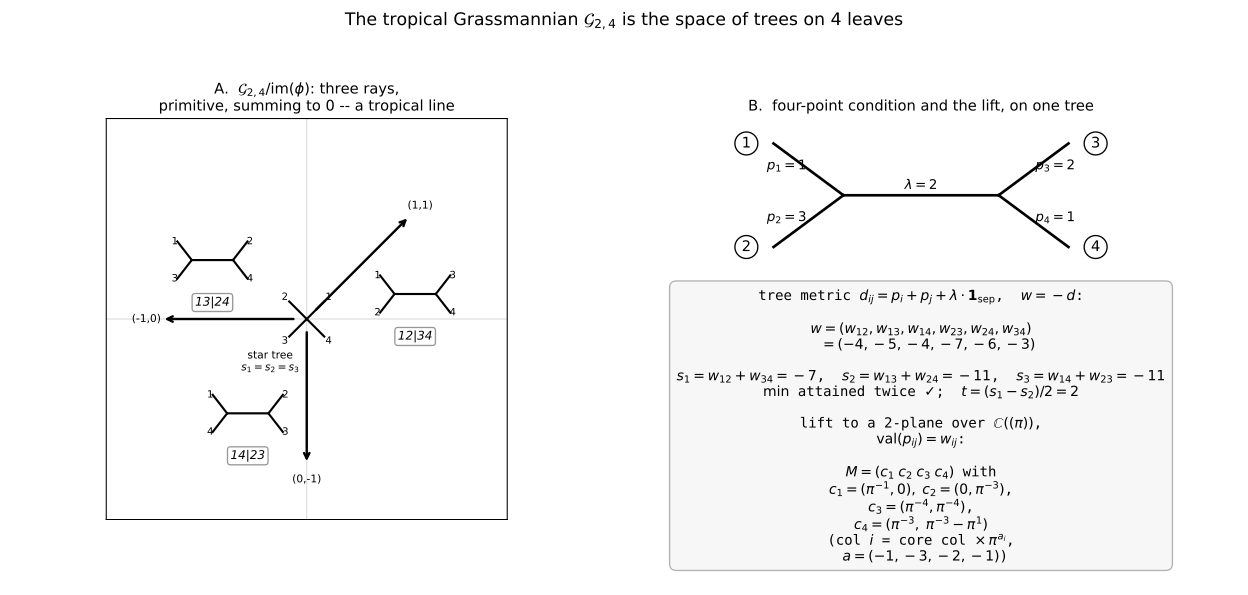
Figure 10.1 — A: the quotient fan (tropical line) with the
three topologies; B: a worked example (tree → w → four-point
tie → the lift matrix of §10.3). Every number drawn was
asserted in the chapter program or the figure script before
rendering.
10.3 Initial forms, and lifting back to an actual plane
A weight is in the tropical variety iff the initial form of the Plücker quadric — the terms attaining the minimum weight — is not a monomial (Thm 2.1(c)). On cone interiors the program finds the binomial for that topology; off the fan, a monomial; 2000 random points, no exceptions.
| topology | strict max | initial form in_w | quotient ray |
|---|---|---|---|
| `12 | 34` | s1 | −p13·p24 + p14·p23 |
| `13 | 24` | s2 | p12·p34 + p14·p23 |
| `14 | 23` | s3 | p12·p34 − p13·p24 |
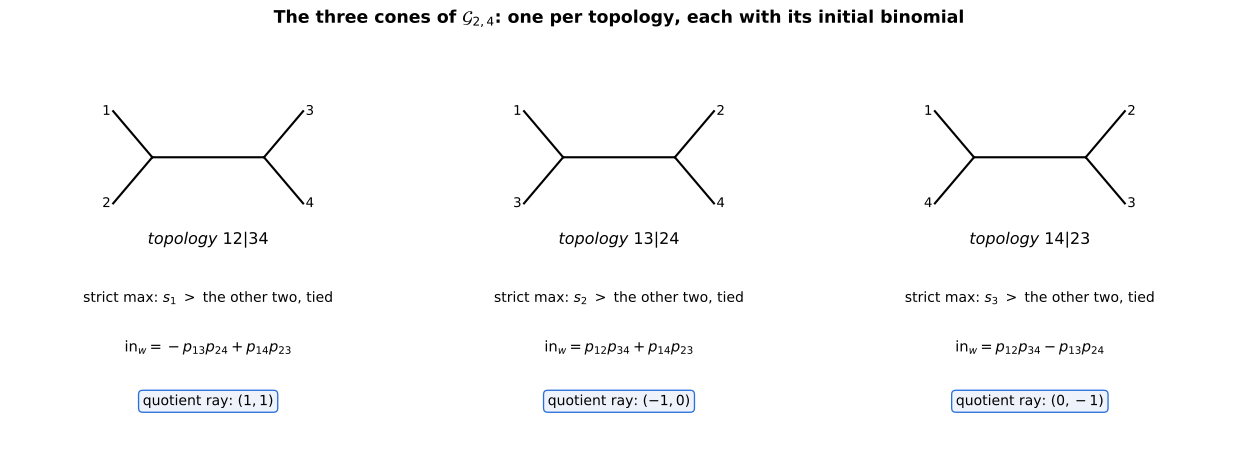
Figure 10.2 — The table above, drawn. Every cell — the strict maximum, the tie, the binomial, the ray — was read off the chapter program by the figure script and asserted before rendering.
More: every fan point lifts. Corollary 2.2 made
constructive: given w = φ(a) − t·E_{12,34} with t > 0, the
2×4 matrix over ℂ((π)) with columns
(1,0), (0,1), (π^{−t}, π^{−t}), (π^{−t}, π^{−t} − π^{t}),
column i then scaled by π^{a_i}, has all six 2×2 minors
with valuations exactly w_ij — verified by exact π-adic
series arithmetic on 8 test points, including the ridge and
the origin, and the six minors of each lift satisfy the
Plücker relation exactly, as series. The tropical point is
not an approximation of a plane; it is the valuation shadow of
one, and the shadow can be reversed.
10.4 The combinatorics of T₄
Tree space T₄ itself: 2³ − 4 − 1 = 3 vertices (the three
splits, as rays), 3!! = 3 facets (the three trivalent trees),
pure of dimension n − 3 = 1 — a tripod, again. The next
chapter takes n = 5, where this graph becomes a famous one.
Honest Box — a sign typo in the paper, caught by computation. Equation (8) of Speyer–Sturmfels as printed gives the cone generators as
+E_{A,B}. With the paper’s own convention “−w_ijis the distance” and its four-point condition (6), a tree metricd = t·E_{12,34}givesw = −t·E, which satisfies (6) but is not inimage(φ) + ℝ≥0·E(writing−tE = φ(a) + sE,s ≥ 0, forcesφ(a) = cEwithc < 0, anda1+a2 = 0,a1+a3 = c,a3+a4 = 0givec = 0— contradiction). The correct generators are−E_{A,B}. This was confirmed against the arXiv TeX source, not just a rendering: the sign in (8) is a typo in the paper. The program asserts both directions:−Elies in the fan’s interior for each topology;+Eviolates the four-point condition outright.
10.5 The whole chapter, as a program
Everything in this chapter is one runnable program: ch10_grassmannian.py — exact Fractions and exact π-adic series throughout, no dependencies beyond the standard library. Its assertions are the chapter’s claims, in ten groups: the sign check on (8) (−E in the fan’s interior, +E out); four-point ⇔ union of the three cones image(φ) − t·E_topo on 4000 random integer points, with the decomposition round-tripped; the quotient fan’s three rays primitive and summing to zero; initial forms binomial on the fan and monomial off it (2000 points); 8 fan points lifted to 2×4 matrices over ℂ((π)) with valuations exact; topology and internal edge t recovered and φ-invariant (500 trials); the T₄ counts (3 vertices, 3 facets); and — added when the draft was re-verified for the book — the Try It answer key below, rank(φ) = 4 with (1,…,1) = φ(½,½,½,½), and the lifted minors satisfying the Plücker relation exactly for all three topologies. Run it, and if it prints its final line, the claims are what we said they are. (This section used to print the listing inline; a screenful of code you can download is just a download with extra scrolling.)
10.6 Try It
- Let
whave pair sumss1 = 5, s2 = 3, s3 = 3. Doeswsatisfy the four-point condition? If so, which topology, and what is the internal edge lengtht? - Why does adding
φ(a)townever changet— in tree language, what doesφ(a)move? - The quotient rays are
(1,1), (−1,0), (0,−1). Verify the balancing condition, and say which topology each ray carries.
Answers
- 1. Yes — the minimum 3 is attained twice. The unique
strict maximum is
s1, so the cherries are{1,2}and{3,4}(topology12|34), andt = (5 − 3)/2 = 1. - 2.
φ(a)shifts every pair sum by the sameΣa(each pair sum adds two disjoint pair-terms covering all four indices once), so the differencess_strict − s_tied— and hencet— are unchanged. In tree languageφ(a)moves pendant (leaf) edge lengths only; the internal edge is the tree’s internal structure, which column scaling cannot touch. - 3.
(1,1) + (−1,0) + (0,−1) = (0,0)— balanced. In the program’s coordinates:(1,1)carries12|34,(−1,0)carries13|24,(0,−1)carries14|23.
What we learned
- Chapter 1’s tripod is a moduli space. The tropical line
is
Gr(2,4)modulo its lineality: its three rays are the three ways to resolve a 4-leaf tree, its vertex is the star tree, and its balancing is the balancing of §10.2 — checked, not quoted. - The tropical point remembers a plane. Every weight in the fan is the valuation vector of an actual 2-plane, by an explicit matrix whose minors satisfy the one Plücker relation exactly — tropicalisation here loses nothing that the valuations were keeping.
- Trust the check, not the printed formula. The paper’s
equation (8) has the wrong sign for its own conventions; the
four-point condition itself, run on
+E, is what convicts it — confirmed against the TeX source before we said so in print.
Next
One rung up, n = 5: tree space T₅ is no longer a tripod but
a graph with 10 vertices and 15 edges — and it is a famous
graph. Chapter 11 proves the Petersen graph is a moduli space:
the tropical Grassmannian Gr(2,5), built from splits.
Source & provenance: Day 10 (2026-10-20) of the tropical
geometry study — code hidden_files/code/day10_grassmannian.py,
figure files/figures/day10-tree-space.png (generator
hidden_files/code/day10_figures.py), study log Day 10 entry,
run log hidden_files/day10-run.log. Source: D. Speyer &
B. Sturmfels, “The tropical Grassmannian”, arXiv:math/0304218 —
Thm 3.4, four-point condition (6), cone generators (8) with the
sign correction of the Honest Box, Ex. 3.2, Cor. 2.2,
Thm 2.1(c) — verified against the arXiv TeX source on Day 10.
The chapter program was merged into one self-contained file
(Day 10 program + the book cycle’s Phase-2 verification script)
and re-run end-to-end on 2026-11-10, all ten assertion groups
passing (run log hidden_files/ch10-run.log). Figures
regenerated as SVG the same day: code
hidden_files/code/ch10_extra_figures.py, which imports the
chapter program, asserts every value it draws — including every
cell of the §10.3 table — and only then renders. Referee pass
2026-11-09 (Nyx, #minplus-book): the dimension bookkeeping of
§10.2 (lineality 4, maximal cones 5 in ℝ⁶, the 4-dimensional
figure being the projective one) is hers as much as ours — her
four sanity anchors were checked one by one, the one
bookkeeping disagreement resolved in her favour on the
substance and stated in §10.2 as above.
Chapter code
The full program behind this chapter, as a download: ch10_grassmannian.py — the same file §10.5 points at. Its assertions are the chapter’s claims; run it.