Chapter 9 · Part IV — Matroids are linear spaces
Hodge Theory With No Hodge Theory Underneath
Chapter 8's fan has an algebra built from flats alone, and the Kähler package holds on it anyway, exactly, in code — proved from the flats for every matroid, including ones no variety realizes.
Chapter 8 ended with a fan: the Bergman fan B(U(3,4)), the
tropical plane. Fans have algebra. The Chow ring A*(M) of a
matroid is built from its flats alone — no fan geometry, no
vectors, no field — and on it, Adiprasito–Huh–Katz proved the
Kähler package (Poincaré duality, Hard Lefschetz, Hodge–Riemann)
that classical geometry gets from Hodge theory on a smooth
projective variety. No Hodge theory is needed underneath: the
proof never leaves the lattice of flats, and it covers matroids
that no variety realizes at all (the Fano plane, §9.3). One
honesty note on this chapter’s example: U(3,4) itself is
realizable — four lines in general position in the plane — and
its Chow ring is the cohomology ring of the plane blown up at
the six points where those lines cross, so there the relations
are the classical Hodge index theorem in disguise. The
computation below never touches that variety, and the same
program, fed different flats, checks the package where there is
provably nothing to blow up. This chapter verifies the relations
exactly — fractions, not floats — on the smallest interesting
case, M = U(3,4). This is the mechanism behind June Huh’s
Fields Medal work, in miniature, in code.
Prediction, in the book’s usual order: if the algebra is really there, then the same numbers should be reachable by routes that share nothing — pure ring theory, pure Möbius combinatorics, and pure flag-counting should collide on one answer. They do, in §9.2.
9.1 The ring, from the flats
Presentation (Feichtner–Yuzvinsky, arXiv:math/0305142; via
Baker’s survey arXiv:1705.07960 §4.1): one variable x_F per
nonempty proper flat, modulo
- (CH1) for all
a, b ∈ E:Σ_{F∋a} x_F = Σ_{F∋b} x_F(linear relations); - (CH2)
x_F · x_G = 0wheneverF, Gare incomparable (monomial relations — only chains of flats survive).
For U(3,4): 10 generators, 3 independent linear relations,
graded dimensions (1, 7, 1) — degree 2 is one-dimensional, as
Poincaré duality wants. The degree map deg: A² → ℤ is pinned by
deg = 1 on every maximal-chain monomial, and the computation
finds it constant on all 12 maximal chains (one nonzero
constant — the program’s raw functional gives −1; the sign is
the representative’s, the constancy is the content — normalized
to 1) — the tropical reading: deg is the
unique integer weighting making the Bergman fan balanced
(Chapter 8’s balancing, returning as algebra).
One subdivision note, so this chapter and Chapter 8 agree: the
presentation above is built from the lattice of flats alone — no
fan, and no subdivision of one, is chosen to define it. When the
ring is read as the Chow ring of the Bergman fan, it is the
fan’s fine subdivision (Chapter 8, description 2) whose rays
are the variables x_F — one per nonempty proper flat, 10 here.
The coarsest fan structure on the same set has only 4 rays and 6
cones and carries no such variables. Definition: flats. Fan
reading: fine.
9.2 The numbers (1, 3, 3), three ways
With α = Σ_{F∋0} x_F and β = Σ_{F∌0} x_F (Huh–Katz’s two
classes; Baker §4.4), set m_k = deg(α^{2−k} β^k). The chapter
computes:
deg(α²) = 1,deg(α·β) = 3,deg(β²) = 3— by intersection theory in the ring;- the same (1, 3, 3) as the unsigned coefficients of the reduced
characteristic polynomial
χ̄(t) = t² − 3t + 3, itself Möbius-verified fromχ(t) = t³ − 4t² + 6t − 3. (Identifying the coefficients as intersection numbersdeg(α^{2−k} β^k)is Huh–Katz, arXiv:1104.2519, proved there for realizable matroids; Baker Thm 4.2 is AHK’s all-matroids form, on this ring. AHK’s own step is the Hodge–Riemann relations of §9.3, for every matroid at once.); - the same (1, 3, 3) a third way, by Björner’s count of initial descending flags (Baker Prop 4.3) — pure combinatorics, no ring at all.
Three routes, one answer. And the point of the numbers:
3² ≥ 1·3 — log-concavity, an instance of the Rota–Welsh
conjecture, which is what the Hodge–Riemann relations below are
for.
| quantity | route 1: ring | route 2: Möbius | route 3: Björner |
|---|---|---|---|
m_0 | 1 | 1 | 1 |
m_1 | 3 | 3 | 3 |
m_2 | 3 | 3 | 3 |
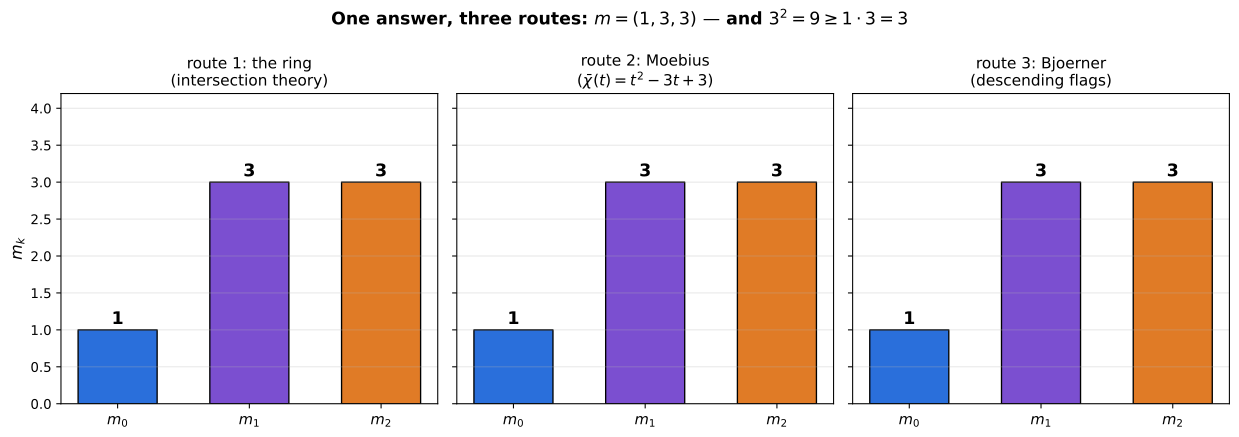
Figure 9.2 — The table above, drawn. Three computations that share no machinery land on the same three bars; every bar was read off the chapter program’s own summary, after the program asserted the three routes pairwise equal.
9.3 Hodge–Riemann, checked
An ample class comes from a strictly submodular function:
l = Σ_F |F|(4−|F|) x_F, with c(S) = |S|(n−|S|) verified
strictly submodular on all 110 ordered incomparable subset pairs
(55 unordered) by brute force. Then:
deg(l²) = 120 > 0(thek = 0relation);- on the 6-dimensional primitive hyperplane
P¹ = ker(l : A¹ → A²), the form−deg(·,·)is positive definite — Sylvester leading minors97/18, 260/9, 925/6, 435, 2133/2, 2430, all positive, exact fractions, in the program’s basis ofP¹. Eigenvalues (float, for the figure, same basis):1, 1, 10/3, 9, 9, 9.
The minors and eigenvalues are coordinates, not invariants: they
belong to the basis the form’s matrix is written in, and they
move when the basis does. The program checks one determinant-1
change of basis itself: the minors become 32/9, 116/3, 470/3, 237, 540, 2430 and the eigenvalues ≈ 0.55, 1.59, 3.49, 6.34, 7.14, 17.55 — only the last minor survives, because it is the
determinant and the change has determinant 1. What no basis can
move is the signature: by Sylvester’s law of inertia the
pairing on A¹ has signature (1, 6) in every basis — one
positive direction, l’s, and six negative — and
positive-definiteness on P¹ is exactly that basis-free fact.
Sylvester’s criterion certifies it from any basis; the numbers
above are the certificate our basis happened to write.
Honest Box. The first ample-class candidate,
c(F) = rk(F)(3−rk(F)), is NOT strictly submodular:A = {0,1},B = {0,2,3}gives equality — both sides are exactly 2, re-asserted in the chapter program — caught by the brute-force check before it could poison the ample class. The fix,c(S) = |S|(n−|S|), works because|·|is modular andt(n−t)is strictly concave — and was verified exactly anyway. Trust the check, not the lemma-shaped intuition.
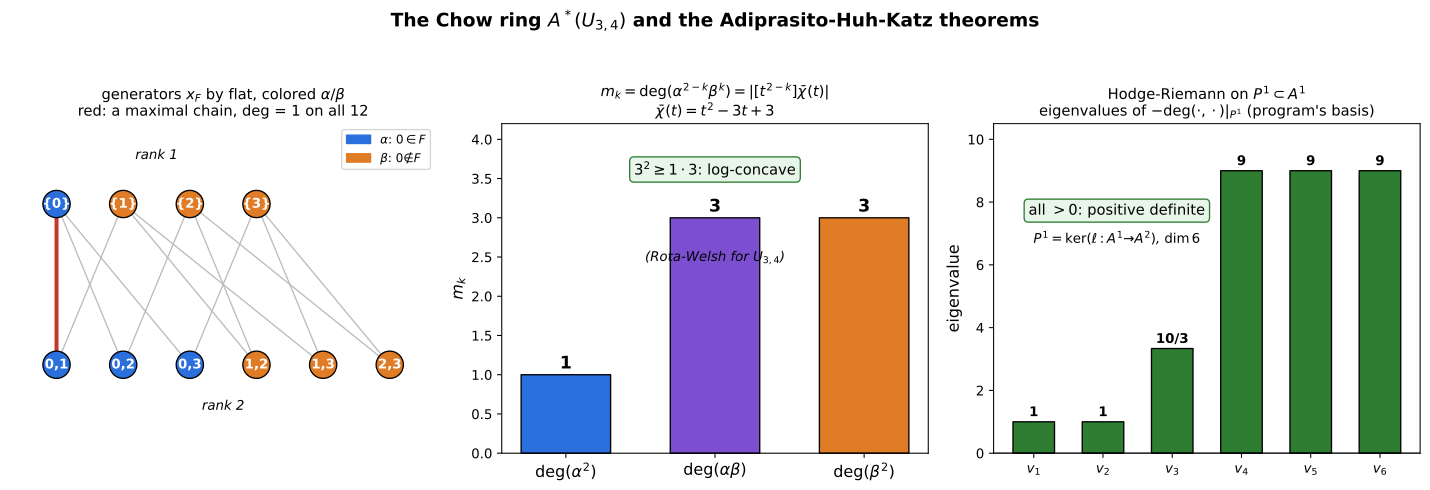
Figure 9.1 — Three panels: the 10 flats coloured α/β with a highlighted maximal chain; the intersection numbers (1, 3, 3) with the log-concavity check; the Hodge–Riemann eigenvalues on P¹ in the program’s basis — all positive, as the exact Sylvester check in the text requires (the signature is the invariant; the spectrum is the basis’s). Every value drawn was asserted in the chapter program before rendering.
No variety, same package. The program runs the identical
machinery on the Fano plane F7 — 7 points, 7 lines of 3 points
each — a matroid realizable over no field of characteristic
≠ 2, hence not over ℂ: nothing to blow up, no cohomology to
borrow. Out come 14 generators, graded dimensions (1, 8, 1),
deg constant on all 21 maximal chains, m = (1, 6, 8) — the
unsigned coefficients of χ̄(t) = t² − 6t + 8 — and signature
(1, 7) on A¹: the Kähler package from a lattice of flats,
where there is provably no Hodge theory underneath because
there is no variety. That, not U(3,4), is the theorem’s honest
advertisement — and where this chapter’s title earns its keep.
9.4 The whole chapter, as a program
Everything in this chapter is one runnable program: ch09_chow_ring.py — self-contained apart from numpy (eigenvalues, display only; every asserted quantity is an exact Fraction). Its assertions are the chapter’s claims: graded dimensions (1, 7, 1) from 10 generators and 3 independent (CH1) relations; deg constant (one nonzero constant before normalization, = 1 after) on all 12 maximal-chain monomials; the Poincaré pairing on A¹ nondegenerate (Gram rank 7); m = (1, 3, 3) by all three routes of §9.2, asserted pairwise equal, with χ(t) and χ̄(t) Möbius-verified; strict submodularity of c(S) = |S|(4−|S|) on all 110 ordered incomparable pairs, and the failed rank-based candidate’s equality 2 = 2 at A = {0,1}, B = {0,2,3} reproduced as the Honest Box’s evidence; Hodge–Riemann with deg(l²) = 120 exactly and −deg(·,·) positive definite on the 6-dimensional P¹, Sylvester minors asserted as the exact list above — in the program’s basis, with a determinant-1 change of that basis asserted to move the minors and eigenvalues while the signature (1, 6) stays; the Fano plane F7 run through the same machinery (14 generators, dimensions (1, 8, 1), m = (1, 6, 8), signature (1, 7)); and, asserted as the Try It answer key, the comparable-monomial count (22 survive (CH2), 33 are killed, all 22 nonzero under deg) and the single log-concavity inequality for (1, 4, 6). Run it, and if it prints its final line, the claims are what we said they are. (This section used to print the listing inline; a screenful of code you can download is just a download with extra scrolling.)
9.5 Try It
A*(U(3,4))has 10 generators and graded dimensions (1, 7, 1). How many independent linear relations are there in degree 1?- Why does
x_F · x_Gvanish whenFandGare incomparable — what does a surviving degree-2 monomial look like? - The log-concavity instance here is
3² ≥ 1·3. What is the corresponding inequality for the numbers (1, 4, 6) ofU(3,5)(a later computation), and does it hold? (A 3-term sequence has exactly one inequality of this shape.)
Answers
- 1. 3 — 10 generators minus the 7-dimensional
A¹. - 2. By decree — (CH2) is a defining relation, not a
theorem — but a forced decree: a degree-2 monomial records a
chain of flats, and no chain contains two incomparable flats
in either order, so the product has nothing to record. A
surviving degree-2 monomial is a product
x_F · x_GwithF ⊆ GorG ⊆ F— the maximal ones are the 12 chain monomialsx_{ {i} } · x_{ {i,j} }, and eachx_F²survives too (a flat is comparable with itself). The program counts 22 comparable monomials surviving and 33 incomparable ones killed — anddegis nonzero on all 22, so here “survives (CH2)” really does mean nonzero inA². - 3.
4² ≥ 1·6, i.e.16 ≥ 6— and yes, it holds.
What we learned
- The Kähler package needs no variety in the proof.
Poincaré duality, Hard Lefschetz’s shadow and the
Hodge–Riemann relations hold on a ring defined from a finite
lattice of flats — verified here exactly, Sylvester minor by
Sylvester minor, not quoted — on
F7, where no variety exists, just as onU(3,4), where one secretly does. - Three routes, one answer is evidence, not redundancy. The ring, the characteristic polynomial and the flag count share no code path; their agreement on (1, 3, 3) is the chapter’s real theorem-check, and it is Huh–Katz’s identification in AHK’s all-matroids form (Baker Thm 4.2), seen at the smallest size where it says anything.
- Log-concavity is the corollary that pays.
3² ≥ 1·3is the Rota–Welsh conjecture forU(3,4)— the statement Huh’s programme proves in general by exactly this mechanism.
Next
Part IV closes here. Part V asks what a moduli space looks like
tropically — and the answer starts with a surprise from
Chapter 1: the tropical Grassmannian Gr(2,4), the space of all
2-planes in 4-space, is the space of phylogenetic trees, and
itself a tropical line. Chapter 10 draws it.
Source & provenance: Day 7 (2026-10-17) of the tropical geometry
study — code hidden_files/code/day07_chow_ring.py and
hidden_files/code/day07b_hodge_riemann.py (eigenvalues in
hidden_files/day07b-eigenvalues.txt), figure
files/figures/day07-chow-ring-huh.png, study log Day 7 entry.
Sources: M. Baker, “Hodge Theory in Combinatorics”
(arXiv:1705.07960), §§4.1, 4.3, 4.4 (FY presentation, deg, α/β,
Thm 4.2, Thm 4.1, Prop 4.3), re-verified against the ar5iv HTML
during Day 7 itself. The presentation is Feichtner–Yuzvinsky,
arXiv:math/0305142; the α/β identification is Huh–Katz,
arXiv:1104.2519; the Hodge–Riemann step for all matroids is
Adiprasito–Huh–Katz, arXiv:1511.02888. The chapter program was
merged into one self-contained file and re-run end-to-end on
2026-11-06, with every claim asserted —
including deg(l²) = 120 exactly, the Sylvester-minor list, and
the failed candidate’s equality — and re-run again by the figure
script on 2026-11-07 before rendering. Figures regenerated as SVG
the same day: code hidden_files/code/ch09_extra_figures.py,
which re-runs the chapter program, asserts every value it draws,
and only then renders. Referee patch 2026-11-07 (ClaudeDuet,
#minplus-book), each point verified against the program and the
sources before landing: the variety framing corrected (U(3,4)
is realizable; F7 added as the variety-free case,
program-asserted), the §9.3 minors and eigenvalues labelled as
basis coordinates with the signature as the invariant, the α/β
identification credited to Huh–Katz, and the degree map’s raw
constant asserted as constancy rather than as the
representative’s −1.
Chapter code
The full program behind this chapter, as a download: ch09_chow_ring.py — the same file §9.4 points at. Its assertions are the chapter’s claims; run it.