Chapter 4 · Part II — Counting curves by taking them apart
Twelve Cubics, Counted on the Floor
A famous count — 12 rational cubics through 8 points — recomputed by taking little oriented graphs apart and putting them back together.
Print edition for handwritten margin notes. Anchors in the left margin (§1.3 ¶2 style) match the web edition — notes digitised from this paper appear at the same anchors online. minplus.xyz
We can draw curves. Now we count them.
Here is a classical question with a famous answer. A rational cubic is a cubic curve of genus 0 — topologically a sphere, not the donut of Chapter 3; think of a cubic with one node (a self-crossing), which is what drops the genus by one. How many rational cubics pass through 8 general points in the plane?
The answer is 12. It has been known since the nineteenth century, and the classical proofs are not things you would want to meet in a dark alley. This chapter recomputes the 12 tropically, using floor diagrams (Brugallé–Mikhalkin): the curve is taken apart into floors and elevators, the pieces are counted by a short program, and the count falls out as
12 = 4 + 5 + 3
— three shapes, each contributing its multiplicity times its number of markings. Then the same program, untouched, counts quartics and lands on 620.
4.1 Predict first: why 8 points, and what should the count feel like?
The number of points is not arbitrary. For degree d, rational plane
curves are counted through
3d − 1 points
Check the small cases against things you already believe:
d = 1: 2 points determine a line — and exactly 1 line passes through them.d = 2: 5 points determine a conic — exactly 1 conic, in general.
So the sequence of counts N_{d,0} starts 1, 1, …. For cubics the
formula gives 8 points. Prediction, before any machinery: the count
should be a specific small integer, and if a tropical method is
worth anything it should reproduce 1, 1 at d = 1, 2 on the way to
whatever d = 3 gives. If it says 12, we will believe the method
because it got the boring cases right first — and because at d = 4
it must then face 620, a number nobody would guess.
Mikhalkin’s correspondence theorem (in its floor-diagram form) is the bridge: under the right hypotheses, counting algebraic curves through points equals a weighted count of tropical objects — here, floor diagrams. We use the theorem; we do not prove it. What we do is implement its counting rule exactly, from the primary source, and check the rule against every classical number within reach.
4.2 Floor diagrams: a curve, taken apart
Picture a building seen from the side. A degree-d floor diagram has
exactly d floors. Between floors run elevators — oriented,
weighted edges. Each floor is also fed by infinite edges coming
from vertices at infinity below it: think of them as the curve’s
ends escaping to infinity, one stub per unit of degree.
Formally, a floor diagram of degree d and genus g is a connected,
acyclic, oriented graph with a weight w(e) ≥ 1 on every edge, such
that:
- there are
dfloors and some vertices at infinity, each 1-valent with its unique edge outgoing (into a floor); - finite edges (elevators) run floor → floor; infinite edges run infinity → floor;
- the weights of the infinite edges sum to
d; - the first Betti number is the genus:
b₁ = g— for rational curves,g = 0, the finite edges form a tree on the floors, so there are exactlyd − 1elevators; - and the rule that does all the work, divergence:
div(v) = (sum of incoming weights) − (sum of outgoing weights) = 1 at every floor.
Divergence is a budget. Every floor receives weight from below —
infinite edges and elevators arriving from lower floors — spends some
of it on elevators leaving upward, and keeps exactly 1. Summing the
budget over all floors forces the infinite weights to total d, which
is why the degree is visible in the diagram at all.
Work one example completely. The first of the three cubic shapes has three floors stacked in a chain. The bottom floor is fed by 3 infinite edges and sends one elevator of weight 2 upward; the middle floor receives that 2 and sends 1 upward; the top floor receives 1 and sends nothing:
| Floor | In | Out | in − out |
|---|---|---|---|
| top | 1 (elevator) | 0 | 1 |
| middle | 2 (elevator of weight 2) | 1 (elevator) | 1 |
| bottom | 3 (infinite edges) | 2 (elevator of weight 2) | 1 |
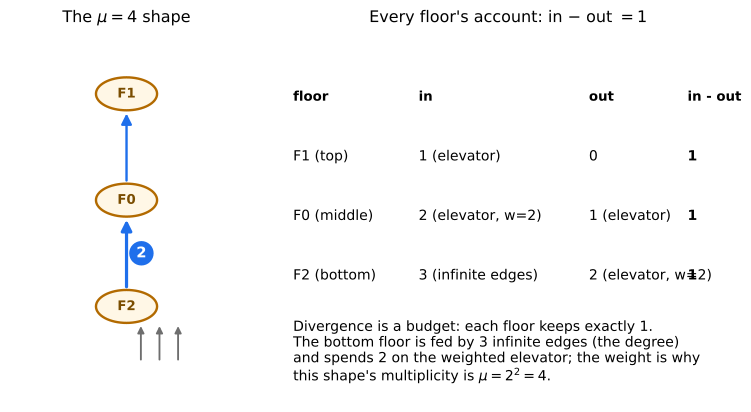
The table, drawn — and the shape itself. Every floor keeps exactly 1. Hold on to that weight-2 elevator: it is about to be squared.
4.3 Two numbers per shape: multiplicity and markings
A shape contributes to the count in two factors.
Multiplicity. Each elevator of weight w contributes w²:
μ(D) = Π over finite edges e of w(e)²
Our worked example has one weight-2 elevator and one weight-1, so
μ = 2² · 1² = 4. (Why squares? That is Mikhalkin’s multiplicity,
inherited from the algebraic side of the correspondence — each
weighted elevator is where several tropical curves glue, and the
gluing is counted with multiplicity w². In this book it is a rule
of the correspondence, verified by its outputs.)
Markings. A diagram by itself is a shape; a marked diagram is a
shape whose pieces have been labelled by the points it passes
through. Precisely: a marking is a bijection from {1, …, 3d − 1} to
the set of floors ∪ edges (for d = 3: 3 floors + 3 infinite edges
- 2 elevators = 8 pieces — the 8 points!), strictly increasing along
the diagram: if an elevator runs from floor
sto floort, its label must lie between theirs (s < e < t), and an infinite edge’s label must be below its floor’s. Markings are counted up to automorphism of the diagram.
So markings are linear extensions of a poset, divided by a symmetry factor — and both parts can bite. Take the second cubic shape: a chain of three floors, all elevators of weight 1, with infinite edges split 2 + 1 between the bottom and middle floors. Its incidence poset:
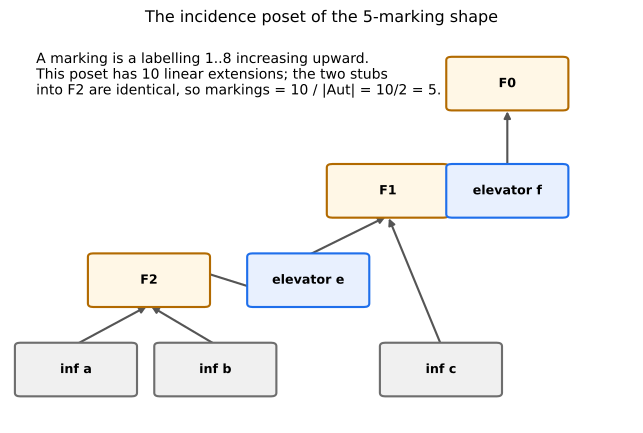
The poset has 10 linear extensions — but the two infinite stubs
into the bottom floor are identical, and swapping them is an
automorphism of the diagram. Markings = 10 / |Aut| = 10 / 2 = 5.
Forget the division and every count in this chapter comes out wrong;
the program asserts the divisibility every single time.
4.4 The count: 4 + 5 + 3 = 12, then 620
There are exactly three floor-diagram shapes of degree 3 and genus
0 (the program enumerates them: divergence determines the infinite
edges once the elevators and their weights are chosen, so the search
is finite — and it re-runs with weights allowed up to d + 1 to
confirm the weight bound loses nothing). The full table:
| Shape | μ | Markings | Contribution |
|---|---|---|---|
| Chain, one elevator of weight 2 (bottom floor fed by 3) | 4 | 1 | 4 |
| Chain, all weights 1 (infinite edges split 2 + 1) | 1 | 5 | 5 |
| Fork: bottom floor splits to two floors (fed by 3) | 1 | 3 | 3 |
| Total | 12 |
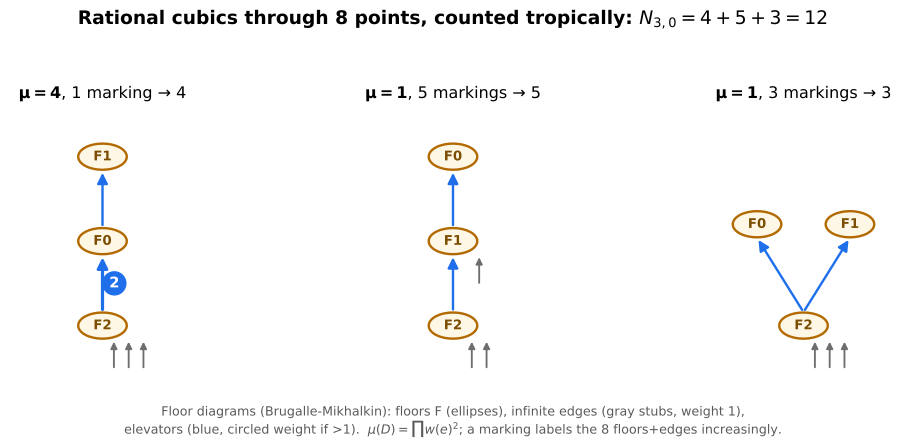
Figure 4.1 — The whole computation, drawn. Left: the weighted chain
(μ = 4, a single marking — the heavy elevator leaves the labels no
freedom). Middle: the split chain of §4.3 (5 markings). Right: the
fork (3 markings). 4 + 5 + 3 = 12.
And then the program keeps going, because a method you trust at
d = 3 should be pushed until it says something you didn’t feed it:
| d | Points (3d − 1) | Shapes | N_{d,0} |
|---|---|---|---|
| 1 | 2 | 1 | 1 |
| 2 | 5 | 1 | 1 |
| 3 | 8 | 3 | 12 |
| 4 | 11 | 12 | 620 |
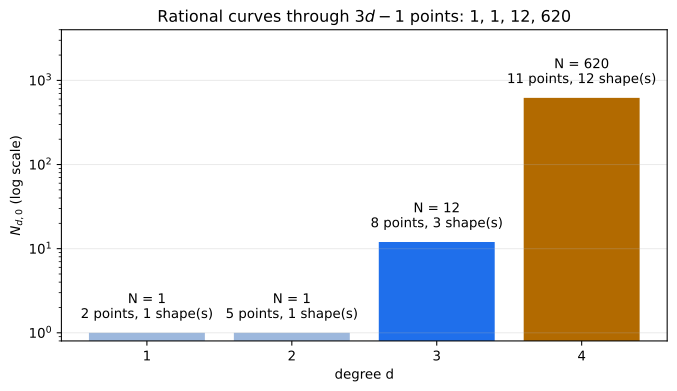
The table, drawn. 620 rational quartics through 11 points is Kontsevich’s number, originally obtained by a famous recursion in mirror symmetry. The floor-diagram program gets it by enumeration: 12 shapes, contributions from 15 up to 102, summing to exactly 620.
Honest Box — the wrong first guess, and a typo in the source. The study’s first implementation of this chapter used a half-remembered divergence rule (out − in, and no infinite edges at all) and produced nonsense. The fix came from reading the primary source — Dedieu’s lecture notes on Brugallé–Mikhalkin — and implementing its definitions as printed. Even then, care was needed: the notes’ condition (1.2)(iii) as printed says the infinite weights sum to
−d, which is impossible for positive weights; the proof of its own Lemma 1.5 uses= d, and= dis what the code implements. A second real bug — canonical representatives relabelled infinite and finite edges by inconsistent permutations, inventing invalid “shapes” — was caught because canonical representatives are asserted to satisfy the diagram axioms. Moral, as ever in this book: the assertions are the chapter.
4.5 The whole chapter, as a program
Everything in this chapter is one runnable program: ch04_floor_diagrams.py. The assertions are the chapter’s claims — run it, and if it prints its final line, the counts are what we said they are. (This section used to print the listing inline; a screenful of code you can download is just a download with extra scrolling.)
4.6 Try It
- Check the fork. The third shape (right panel of Figure 4.1) has the bottom floor fed by 3 infinite edges, sending one weight-1 elevator to each of two top floors. Verify divergence = 1 at all three floors, and compute μ.
- Quintic points. How many points does the count
N_{5,0}run through? (The classical value, for when a faster program comes along: 87304.) - A heavy diagram. A (hypothetical) diagram has finite-edge weights 2 and 3, and 2 markings. What is its contribution?
- Why d − 1 elevators? For genus 0, use the vertex/edge count:
dfloors +dvertices at infinity,dinfinite edges +Ffinite ones, and a connected acyclic graph hasE = V − 1. Solve forF.
Answers
- 1. Bottom floor: in 3, out 1 + 1 = 2, div 1 ✓. Each top
floor: in 1, out 0, div 1 ✓.
μ = 1² · 1² = 1— the fork’s contribution is all in its 3 markings. - 2.
3 · 5 − 1 =14 points. - 3.
μ = 2² · 3² = 36; contribution36 · 2 =72. - 4.
V = 2d,E = d + F;d + F = 2d − 1givesF = d − 1. Genus 0 is the tree condition — Chapter 6 will break it on purpose, with parallel edges.
What we learned
- Counting curves can be combinatorics. Mikhalkin’s correspondence turns “how many rational cubics through 8 points?” into a finite enumeration of oriented graphs with weights.
- Divergence = 1 is the engine. It determines the infinite edges from the elevators, keeps the search finite, and encodes the degree.
- Every shape pays twice: once in multiplicity (
Π w²— weights are never decoration) and once in markings (linear extensions, divided by automorphisms — symmetries are never decoration either). - The method scales past its teaching example: the same assertions that verify 12 also verify 620.
Next
Chapter 5 asks curves to do more than pass through points: to touch a fixed line, to order. Tangency turns into two kinds of infinite edge — fixed (α) and moving (β) — and the counts 12 become 36 and 10, with the same machinery and one subtle correction about how fixed edges are labelled.
Source & provenance: Day 3 (2026-10-13) of the tropical geometry
study — code hidden_files/code/day03_floor_diagrams.py (run log
hidden_files/day03-run.log), figure
files/figures/day03-floor-diagrams-12-cubics.png, study log Day 3
entry. Definitions implemented from T. Dedieu, “Two lectures on the
enumeration of curves by means of floor diagrams” (arXiv:2511.21123),
Lecture IX §1.1–1.3. The chapter program was re-run end-to-end on
2026-11-01 while finishing this chapter (all assertions passed,
including the per-shape d = 3 breakdown and the d = 4 total 620). The
three extra figures (divergence accounts, the incidence poset, the
counts growth chart) were added the same day: code
hidden_files/code/ch04_extra_figures.py, which imports the chapter
program and asserts each figure’s numbers — divergence accounts,
multiplicities, markings (10 linear extensions / |Aut| 2 = 5), and the
full 1, 1, 12, 620 table — before rendering.
Chapter code
The full program behind this chapter, as a download: ch04_floor_diagrams.py — the same file §4.5 points at. Its assertions are the chapter’s claims; run it.