Chapter 3 · Part I — Curves, tropicalised
The Cubic Has a Donut Inside It
One interior lattice point, one cycle: the tropical elliptic curve, predicted before it is drawn.
Every classical geometer knows the smooth cubic by its other name: an elliptic curve, genus 1, topologically a torus — a donut. Chapter 2 proved, with a lattice-point count, that no conic could ever grow a cycle. This chapter cashes the cheque Chapter 2 wrote: at degree 3 the Newton triangle acquires exactly one interior lattice point, and the tropical cubic grows exactly one cycle. We will predict the entire curve — vertices, edges, rays, the cycle, even its length — from the triangle alone, before computing, and then make the computation sign for every line.
3.1 Predict first (the house rule, applied)
The degree-3 Newton triangle has corners (0,0), (3,0), (0,3) and ten lattice points. Exactly one is interior:
(1, 1) — since (d−1)(d−2)/2 = 1 for d = 3
Now choose heights designed to subdivide the triangle into unit triangles (a unimodular triangulation — the tropical meaning of “smooth”):
c(i, j) = i² + j² + i·j
(The cross term i·j is doing real work: it breaks the flat spots
that i² + j² alone leaves at this degree, giving a full 6-triangle
fan around (1,1).) Predictions, all from Chapter 2’s dictionary:
- 9 faces. The triangle has area 9/2; unit triangles have area ½. So a unimodular triangulation has exactly 9 faces → 9 vertices on the curve.
- 9 rays. The boundary has 9 unit edges (3 per side), each dual to a weight-1 ray: 3 each in directions (0,1), (1,0), (−1,−1). Total weight 3 per direction — degree 3, read at infinity.
- 9 bounded edges. Count edge-face incidences:
3·9 = 27 = 2·(interior edges) + 9(boundary), so interior edges — dual to bounded curve edges — number 9. - Genus 1.
g = E − V + 1 = 9 − 9 + 1 = 1. And by Chapter 2’s theorem it must be 1: one interior point. - The cycle is the star of (1,1). A point inside the triangulation is surrounded by triangles — its star. Vertices of the curve dual to star faces are arranged in a ring, because the star is a fan. With 6 triangles around (1,1), expect a 6-cycle; the other 3 bounded edges are bridges — trees grafted onto the ring, connecting it to the three corner vertices.
If the computation disagrees with any of this, either the code or the dictionary is wrong, and either way we learn something. Run it.
3.2 The computation signs
The full Day 2 program computes the subdivision from the lower hull (it does not take the triangulation on faith), solves each face’s tie equations, and asserts its way down the prediction list. Result:
- 9 unit triangles, exactly tiling the triangle. ✓
- 9 vertices; three spot-checks solved by hand in advance — face {(0,0),(1,0),(0,1)} ↦ (−1,−1), {(1,0),(2,0),(1,1)} ↦ (−3,−2), {(1,0),(0,1),(1,1)} ↦ (−2,−2) — all match the computation exactly. ✓
- Balancing asserted at all 9 vertices. ✓
- 9 bounded edges, 9 rays with direction multiset {3×(0,1), 3×(1,0), 3×(−1,−1)}, all weight 1. ✓
- All vertices, edge-midpoints and ray tips found on the sampled mask; all 9 rays inferred back from the mask alone (Chapter 2’s bitmap method, re-centred on the curve), snap error 0.00°, balancing on inferred directions = (0, 0). ✓
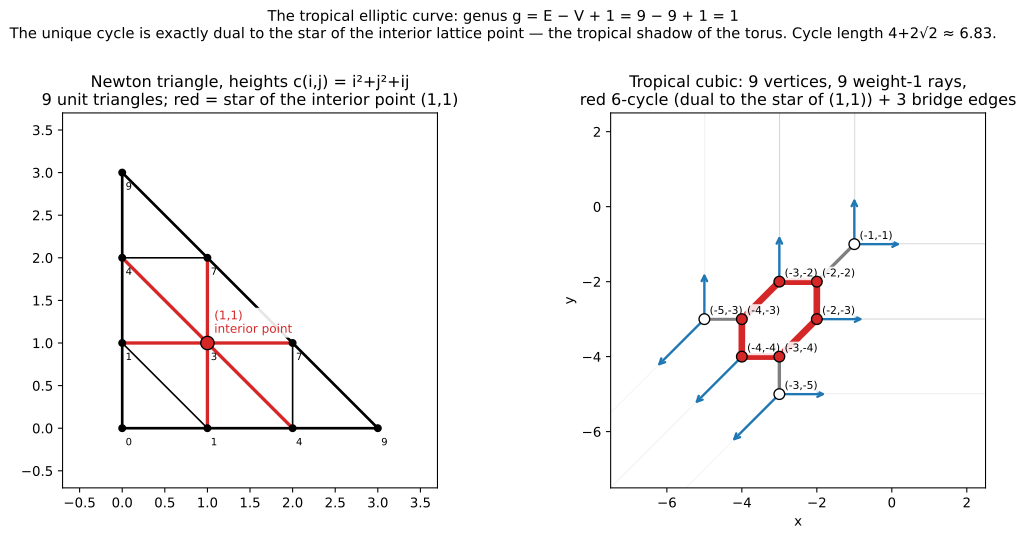
Figure 3.1 — Left: the Newton triangle, the star of the interior point (1,1) shaded red. Right: the tropical cubic — red 6-cycle, grey bridges, blue rays. The red on the left is the red on the right, dualised.
3.3 Finding the cycle: leaf-stripping
How do you prove the bounded graph’s only cycle is the predicted ring, rather than eyeballing the picture? Strip it:
Leaf-stripping. Repeatedly delete vertices of degree 1 (with their edge). Trees are eaten completely — every tree has a leaf, and deleting leaves creates new leaves until nothing is left. Whatever survives, survives because every vertex on it has degree ≥ 2. For our graph, what survives is exactly the cycle.
Applied to the 9-vertex bounded graph: the three corner vertices (faces (0,0),(1,0),(0,1); (2,0),(3,0),(2,1); (0,2),(1,2),(0,3)) are degree-1 and get stripped, and stripping stops on 6 vertices, 2-regular — a single 6-cycle. Then the duality check, which is the chapter’s real theorem:
- The 6 cycle vertices are exactly the faces containing (1,1) — the star. No more, no fewer.
- Every cycle edge is dual to a subdivision edge incident to (1,1).
- The other 3 bounded edges are verified bridges (delete one and the graph disconnects — the computational definition of “tree part”).
So the cycle isn’t near the interior point, or caused by it in some vague sense. The cycle is the star, read in the dual picture: each interior lattice point contributes its star, and the star dualises to a cycle. One interior point, one cycle. This is Chapter 2’s genus formula with its sleeves rolled up.
Even the cycle’s size is computable, edge by edge from the vertex coordinates: four edges of length 1 and two of length √2, total
L = 4 + 2√2 ≈ 6.828
Remember that number. Much later in this book (Part VI) this cycle
acquires a group law, and L becomes the circumference of its
Jacobian — the tropical elliptic curve turns out to be, metrically,
a circle of length 4 + 2√2 wearing a graph as a name tag.
3.4 The classical postcard
Classically: a smooth plane cubic is a torus; its genus, computed by
adjunction, is (3−1)(3−2)/2 = 1. Tropically: the bounded graph’s
first Betti number is 1. Same number, same formula, two worlds.
The tropical curve is often described as the skeleton the torus
leaves behind when the complex structure degenerates — the donut
deflated onto its core circle, with trees where the rest of the
surface used to hang. That’s not just a metaphor in this book’s later
chapters; Part VI does divisor theory on the graph itself and
recovers the elliptic curve’s group law as rotation of the cycle.
3.5 The whole chapter, as a program
from fractions import Fraction as F
from itertools import combinations
import math

PTS = [(0,0), (1,0), (2,0), (3,0), (0,1), (1,1), (2,1), (0,2), (1,2), (0,3)]
C = {p: p[0]**2 + p[1]**2 + p[0]*p[1] for p in PTS}   # heights i^2+j^2+ij
def val(p, x, y): return C[p] + p[0]*x + p[1]*y

# the regular triangulation (computed from the lower hull in the full program)
FACES = [{(0,0),(1,0),(0,1)}, {(2,0),(3,0),(2,1)}, {(0,2),(1,2),(0,3)},
         {(1,0),(2,0),(1,1)}, {(1,0),(0,1),(1,1)}, {(2,0),(1,1),(2,1)},
         {(1,1),(2,1),(1,2)}, {(1,1),(0,2),(1,2)}, {(0,1),(1,1),(0,2)}]
VERTS = [(-1,-1), (-5,-3), (-3,-5), (-3,-2), (-2,-2),
         (-4,-3), (-4,-4), (-3,-4), (-2,-3)]

def area2(face):
    (x1,y1),(x2,y2),(x3,y3) = sorted(face)
    return abs(x1*(y2-y3) + x2*(y3-y1) + x3*(y1-y2))
for face, (x, y) in zip(FACES, VERTS):
    assert area2(face) == 1                            # unit triangles
    vals = {p: val(p, F(x), F(y)) for p in PTS}
    m = min(vals.values())
    assert {p for p, v in vals.items() if v == m} == face
assert sum(area2(f) for f in FACES) == 9               # tiles area-9/2 triangle

# bounded edges = subdivision edges shared by two faces; rays dual to the rest
bounded, boundary = [], 0
all_edges = {}
for a, b in combinations(range(9), 2):
    shared = FACES[a] & FACES[b]
    if len(shared) == 2:
        bounded.append((a, b))
for f in FACES:
    for e in combinations(sorted(f), 2):
        all_edges[e] = all_edges.get(e, 0) + 1
boundary = sum(1 for n in all_edges.values() if n == 1)
assert len(bounded) == 9 and boundary == 9             # 9 bounded, 9 rays

# leaf-strip the bounded graph: trees fall off, the cycle remains
adj = {i: set() for i in range(9)}
for a, b in bounded:
    adj[a].add(b); adj[b].add(a)
rem = {v: set(n) for v, n in adj.items()}
changed = True
while changed:
    changed = False
    for v in [v for v, n in rem.items() if len(n) == 1]:
        (u,) = rem[v]; rem[u].discard(v); del rem[v]; changed = True
cycle = set(rem)
star = {i for i, f in enumerate(FACES) if (1, 1) in f}
assert cycle == star and len(cycle) == 6               # cycle = star of (1,1)
assert all(len(n) == 2 for n in rem.values())          # 2-regular: one cycle
cyc_len = sum(math.dist(VERTS[a], VERTS[b]) for a, b in bounded if a in cycle and b in cycle)
assert abs(cyc_len - (4 + 2*math.sqrt(2))) < 1e-9, cyc_len

genus = len(bounded) - len(FACES) + 1
interior = [p for p in PTS if p[0] > 0 and p[1] > 0 and sum(p) < 3]
assert genus == 1 and interior == [(1, 1)]
print(f"Chapter 3: all assertions pass. Genus: {genus} | cycle length: {cyc_len:.3f}")
Chapter 3: all assertions pass. Genus: 1 | cycle length: 6.828
Honest Box — what this program checks. As in Chapter 2, the compact program lists the triangulation and verifies everything downstream, exactly: unit areas, tiling, global ties at all 9 vertices, edge counts, the leaf-stripping, cycle = star, cycle length, genus. The triangulation itself (lower hull via
ConvexHull), balancing at all 9 vertices, the bridge checks, and the mask inference of the 9 rays are asserted in the full program (ch03_tropical_cubic.py, the study’s Day 2 code) — which was re-run end-to-end while this chapter was being written, and passed.
3.6 Try It
- Predict the quartic. Using only the dictionary: for a smooth
tropical quartic (degree 4, heights giving a unimodular
triangulation), predict (a) the number of faces/vertices, (b) the
number of rays, (c) the number of bounded edges — use
3F = 2E_int + E_boundary— and (d) the genus. Check (d) against Chapter 2’s interior-point count (Try It 2.9.3). - Strip by hand. Draw (on paper!) the bounded graph from the chapter program’s bounded-edge list — faces 0–8, edges from shared sides — and leaf-strip it with a pencil. Which three vertices fall off? Confirm the survivors are exactly the faces containing (1,1).
- Break smoothness. The face {(0,0),(1,0),(0,1)} is a unit triangle. Merge it with {(1,0),(0,1),(1,1)} into one quadrilateral face. What happens to the dual vertex’s valence, and to weighted balancing there? (Qualitative answer is fine — this is what “non-smooth” means tropically, and Part II will meet worse.)
Answers
- 1. (a) Triangle area
4²/2 = 8, unit triangles of area ½ → 16 faces = 16 vertices. (b) Boundary unit edges: 4 per side → 12 rays. (c)3·16 = 48 = 2E_int + 12→ E_int = 18 bounded edges. (d)g = 18 − 16 + 1 =3, matching the 3 interior points (1,1), (1,2), (2,1). ✓ (Day 18 of the study built exactly this curve: its skeleton is three hexagons, pairwise sharing an edge — a Deep Dive in Part VII.) - 2. The corner faces 0, 1, 2 fall off — dual to the triangles at the Newton triangle’s corners. The survivors are faces 3–8, each containing (1,1).
- 3. The two vertices merge into one vertex where four edges meet (valence 4 instead of 3+3 across an edge). Balancing can still hold — it’s a sum over all edges at the vertex — but the curve is no longer trivalent, i.e. no longer “smooth”: tropically, a merged face is a singular point where two vertices collided, the same collision story as Chapter 2’s warm-up, one dimension up.
What we learned
- The dictionary is predictive: faces, rays, bounded edges and genus were all computed from the Newton triangle before the curve was drawn — and the curve complied.
- Interior lattice points ↔ cycles, concretely: a point’s star dualises to a cycle; leaf-stripping isolates it; bridges are the trees grafted on.
- The tropical cubic’s cycle has a metric: length
4 + 2√2, the circumference its Jacobian will turn out to have. - Genus is one number computed three compatible ways:
E − V + 1, interior points,(d−1)(d−2)/2.
Next — Part II: counting curves
We can draw curves. Now we count them. Classical algebraic geometry asks: how many rational cubics pass through 8 general points? (Answer: 12 — and for centuries you needed heavy machinery to prove it.) Chapter 4 counts them tropically, by taking floor diagrams apart and putting them back together — and lands on 12, then 620 quartics, with a program small enough to fit in a chapter.
Source & provenance: Day 2 (2026-10-12) of the tropical geometry
study — code hidden_files/code/day02_tropical_cubic.py (run log
hidden_files/day02-run.log), figure
files/figures/day02-tropical-cubic.png, study log Day 2 entry. The
full Day 2 program was re-run end-to-end on 2026-10-30 while drafting
(all checks passed); the compact code in §3.5 was executed separately
and passed the same day.
Chapter code
The full program behind this chapter, as a download: ch03_tropical_cubic.py. The inline listing in the chapter is the compact, self-checking version.