Chapter 12 · Part VI — Chip-firing, sandpiles, and Jacobians
The Sandpile Group of a Donut
The cycle inside Chapter 3's cubic is its own Jacobian: its sandpile group is Z/6, Abel–Jacobi is a bijection, and adding points is rotating the hexagon.
Part VI opens where Chapter 3 left a loose end. The smooth tropical cubic had a cycle inside it — a hexagon, dual to the star of the interior lattice point — and we called that cycle the tropical shadow of the elliptic curve’s torus, its donut. Classically, a donut carries a group law: points on an elliptic curve add. This chapter asks what becomes of that group law tropically, and the answer is the cleanest one in the book so far:
The cycle is its own Jacobian. Its sandpile group is
ℤ/6, Abel–Jacobi is a bijection, and addition of points is rotation of the hexagon.
Everything is Baker–Norine chip-firing theory on a finite
graph (M. Baker & S. Norine, “Riemann–Roch and Abel–Jacobi
theory on a finite graph”, arXiv:math/0608360), computed on
the 6-cycle C₆. Definitions and the stabilisation algorithm
were taken from the paper — Proposition 3.1, verified against
the text — not from memory.
12.1 The graph, and what a divisor is
Work with the cycle on its own: vertices v₀,…,v₅ in cyclic
order, six edges, genus
g = E − V + 1 = 6 − 6 + 1 = 1.
A divisor is just an integer at every vertex,
D = Σ D(vᵢ)·(vᵢ) — read D(vᵢ) as a pile of that many
chips at vᵢ (negative = debt). Its degree is the total
Σ D(vᵢ). Firing a vertex sends one chip along each
incident edge to a neighbour; on the cycle, firing v is
subtracting the v-th column of the Laplacian Q
(degree on the diagonal, −1 per edge off it). Divisors
reachable from 0 by firing scripts are principal;
degree-0 divisors modulo principal ones form the
Jacobian (sandpile / critical group)
Jac(G) = Div⁰(G) / Prin(G).
Predict first. A cycle graph has exactly as many spanning
trees as vertices — delete any one edge — so Kirchhoff’s
Matrix-Tree theorem predicts |Jac(C₆)| = 6 before any group
structure is computed. §12.4 collects that bet three ways.
12.2 Stabilisation, done honestly: q-reduced divisors
Fix a base vertex q = v₀. A divisor is q-reduced if
- (P1) it has no debt away from
q, and - (P2) every nonempty set
A ⊆ V ∖ {q}contains a vertexvwithD(v) < outdeg_A(v)— Dhar’s burning condition. Read it as a burn: set fire toq; a vertex burns once the fire reaches it along more edges than it holds chips. ThenDis q-reduced iff the fire fromqburns the whole graph — a vertex that would survive the burn is exactly a vertex of a violating set. (The chapter program checks this burning test agrees with P1+P2 on all 1024 degree-0 divisors with entries in{-1,0,1,2}away fromq.)
Baker–Norine Proposition 3.1 says every class has exactly
one q-reduced representative, reached by their algorithm:
first take vertices out of debt, farthest-from-q first (a
preceding neighbour fires; fixed vertices only gain chips,
so each is fixed once), then repeatedly fire violating
sets — sets A where every v ∈ A can fire out of A —
until none remain. The program implements that algorithm
literally and asserts its postconditions on every call:
the output is q-reduced, the degree is unchanged, and
D − D_q = Q·f for the tracked firing script f.
Stabilisation is also asserted confluent — same answer for
lexicographic and reversed subset order — on 30 random
degree-0 divisors.
Honest Box — “stable” is not “q-reduced”. The first implementation of this material (Day 8 of the study) used the naive loop everyone writes first: fire a vertex that has enough chips, borrow at a vertex in debt. Its outputs look stable, and the run’s own assertions killed it: the divisor
[-3, 1, 1, 1, 0, 0]has no debt away fromqand no vertex away fromqable to fire alone, yet it fails Dhar’s condition onA = {1,2,3}— one of its three violating sets{1,2},{2,3},{1,2,3}(each vertex ofAholds exactly its out-degree toAᶜ), so it is not q-reduced — and indeed it stabilises, under firing sets, all the way to0. The eye test is not the definition. The counterexample is kept in the program as a regression test, and it is the reason this chapter’s stabiliser fires sets, not vertices.
12.3 Counting the reduced divisors first
Before computing the group, count its elements a second
way. A q-reduced degree-0 divisor on C₆ must satisfy
D(v) ∈ {0,1} at every v ≠ q (P2 with A = {v} forces
D(v) < deg(v) = 2). Enumerating those 2⁵ candidates and
keeping the ones passing the full burning condition gives
exactly 6 q-reduced degree-0 divisors — the G-parking
functions — matching the Matrix-Tree prediction of §12.1.
One representative per class, six classes: the counting is
already consistent before the group law appears.
12.4 The sandpile group is ℤ/6, three ways
- Matrix-Tree.
detof any reduced Laplacian ofC₆is6— six spanning trees, so|Jac| = 6. - Smith normal form. The reduced Laplacian’s SNF is
diag(1, 1, 1, 1, 6), soJac(C₆) ≅ ℤ/1 × ℤ/1 × ℤ/1 × ℤ/1 × ℤ/6 ≅ ℤ/6— cyclic. - Abel–Jacobi (§12.5). The six point-classes below are
pairwise distinct, so
|Jac| ≥ 6; and Baker–Norine Theorem 1.7 saysS^(k)is surjective iffk ≥ g— herek = g = 1, so every class is a point-class and|Jac| ≤ 6. This route never touches the determinant: the count is forced by the explicit list plus surjectivity. (The program checks the surjectivity computationally: the Abel–Jacobi image is exactly the set of six q-reduced degree-0 divisors.)
Three routes — a determinant, a normal form, an explicit list — landing on the same group. That redundancy is the chapter’s standard of evidence, inherited from the study.
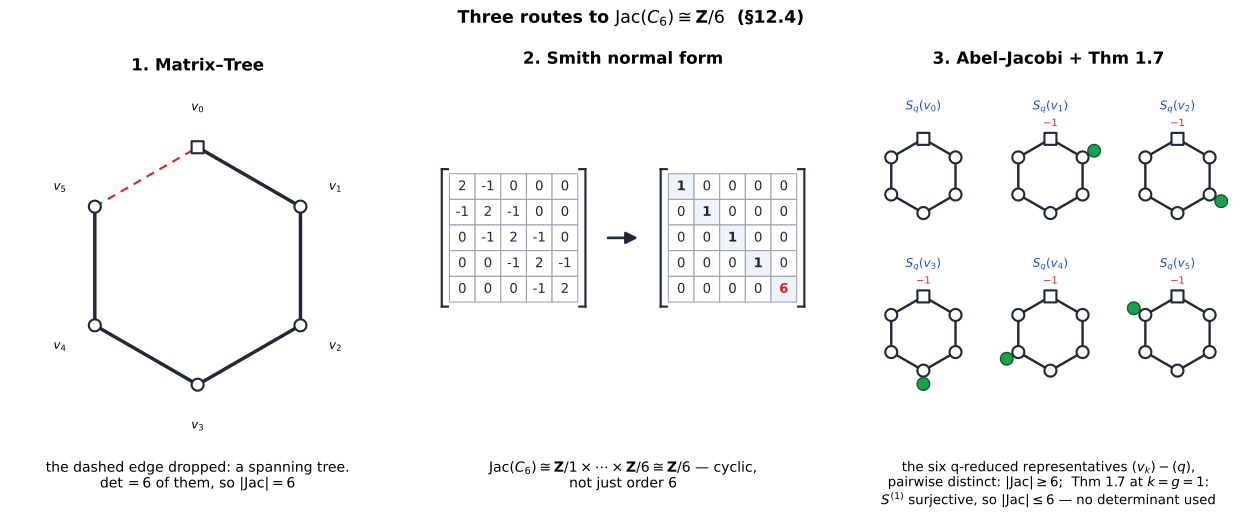
Figure 12.2 — §12.4, drawn. Every number in it — the determinant, the SNF diagonal, the six representatives — was recomputed by the figure script from the chapter program and asserted before rendering.
12.5 Abel–Jacobi is a bijection
The Abel–Jacobi map sends a vertex to the class of the
degree-0 divisor (vᵢ) − (q); write S_q(vᵢ) for its
q-reduced representative. The program computes:
v₀ ↦ [ 0, 0, 0, 0, 0, 0]
v₁ ↦ [-1, 1, 0, 0, 0, 0]
v₂ ↦ [-1, 0, 1, 0, 0, 0]
v₃ ↦ [-1, 0, 0, 1, 0, 0]
v₄ ↦ [-1, 0, 0, 0, 1, 0]
v₅ ↦ [-1, 0, 0, 0, 0, 1]
Six distinct classes, and by §12.4’s third route there
are no others: the map S^(1) : V → Jac is a bijection
of sets. This is Baker–Norine’s Theorems 1.7–1.8 in
miniature: Theorem 1.7 says S^(k) is surjective iff
k ≥ g (here g = 1, so S^(1) already surjects), and
Theorem 1.8 says S^(k) is injective iff the graph is
(k+1)-edge-connected — at k = 1 that is exactly
2-edge-connected. The program asserts every cut of C₆
has at least 2 edges, so the hypothesis is checked, not
assumed. Keep this hypothesis in mind: Chapter 13 breaks
it on purpose, by grafting trees onto the cycle, and
watches injectivity fail in exactly the way the theorem
predicts.
12.6 The group law is rotation
Let g = S_q(v₁), the class of the vertex one step round
the cycle. Adding g to itself (add representatives,
re-reduce) the program finds g has order exactly 6, and
then checks the full multiplication table in one line:
S_q(vᵢ) + S_q(vⱼ) = S_q(v_{i+j mod 6}) for all i, j.
So under Abel–Jacobi the Jacobian does not merely have the same size as the vertex set — the vertex set, with addition = rotation of the hexagon, is the group. This is the tropical shadow of the elliptic-curve group law: classically, points of a smooth cubic add by chord-and- tangent, and the curve is its own Jacobian; tropically the cubic has collapsed to its cycle, chord-and-tangent has degenerated away, and what survives of the group law is rotation around the loop. The donut remembers it was a group.
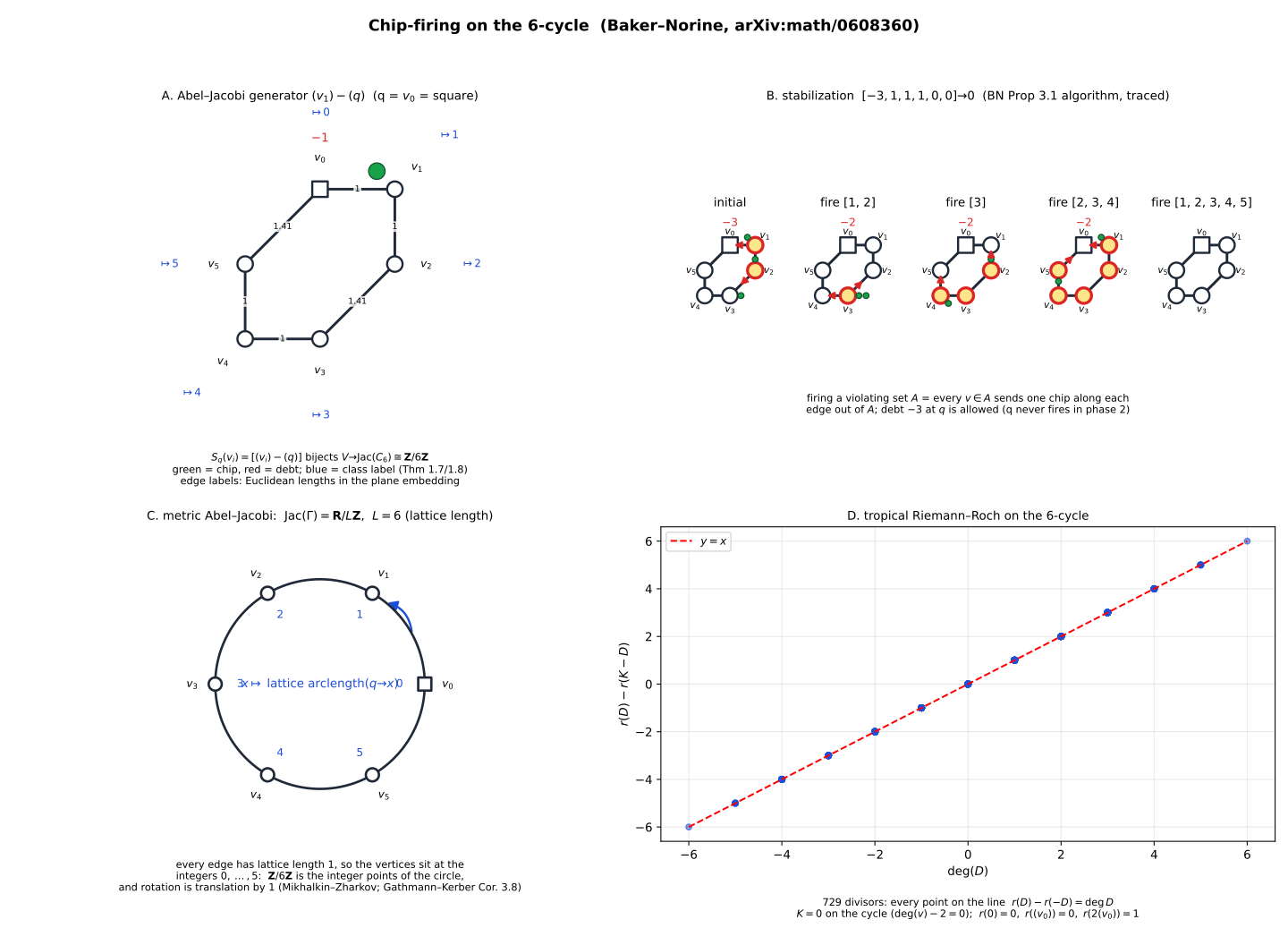
Figure 12.1 — A: the cycle with its Abel–Jacobi generator
and ℤ/6 labels (§§12.5–12.6); edge labels are the
Euclidean lengths of the plane embedding. B: the traced
stabilisation of the Honest Box counterexample
[-3,1,1,1,0,0] → 0, firing sets {1,2}, {3},
{2,3,4}, {1,…,5} (§12.2). C: the metric Jacobian
ℝ/6ℤ with the vertices at the integer points 0,…,5
(§12.8) — redrawn for this chapter with equal lattice
spacing; the study’s original drawing spaced them by
Euclidean arclength. D: Riemann–Roch scatter — all 729
divisors of §12.7 on the line y = x.
12.7 Riemann–Roch, brute-forced
For a divisor D, the rank r(D) is the largest s
such that D − E is equivalent to an effective divisor for
every effective E of degree s (−1 if D itself is
not). The canonical divisor is
K = Σ (deg(v) − 2)·(v); on the 2-regular cycle every term
vanishes, so K = 0 and deg K = 0 = 2g − 2, as it must.
Tropical Riemann–Roch (Baker–Norine Thm 1.12) says
r(D) − r(K − D) = deg(D) + 1 − g,
which here reads r(D) − r(−D) = deg(D). The program
verifies it on all 3⁶ = 729 divisors with entries in
{-1, 0, 1}, rank computed from the definition (via the
q-reduced representative, which is effective iff the class
is), after the hand checks r(0) = 0, r((v₀)) = 0,
r(2(v₀)) = 1, and r(K) = g − 1 = 0. No sampling: the
finite box is exhausted, and every divisor in it obeys the
theorem. It is worth saying what the box actually tests
once K = 0: for deg D ≥ 1, −D has negative degree so
r(−D) = −1 and the theorem collapses to
r(D) = deg D − 1; at degree 0 it says D ∼ 0 iff
−D ∼ 0. The program asserts both readings separately
(294 divisors of the first kind, 141 of the second).
A remark worth keeping (Baker–Norine Remark 1.13(iii)):
L(D) ∪ {∞} is naturally a finitely generated semimodule
over the tropical semiring (ℕ ∪ {∞}, min, +) — its
addition is pointwise min (the program checks L(D) is
closed under pointwise min in bounded boxes) — so
Chapter 1’s min-plus arithmetic shows up inside divisor
theory itself, not just in the geometry that produced the
graph.
12.8 Metric coda: the Jacobian is a circle
Chapter 3’s cycle is not abstract: its edges have lengths.
But which lengths? Measured with a Euclidean ruler in the
plane, the six edges (in cyclic order) are
1, 1, √2, 1, 1, √2, totalling 4 + 2√2 ≈ 6.828 — that is
the number Chapter 3 originally printed. The tropical
metric is not the Euclidean one: an edge’s length is its
lattice length, the factor by which its displacement
stretches the primitive integer direction along it. The two
diagonal edges have displacement (1,1) (resp. (−1,−1))
— exactly 1 × the primitive direction (1,1) — so their
lattice length is 1, not √2; the four axis edges have
lattice length 1 as well. Every edge has lattice length
1, and the total is
L = 6.
(The program recomputes this from Chapter 3’s vertex
coordinates: Euclidean total 4 + 2√2, lattice total 6.
Chapter 3’s §3.3, its leaf-stripping caption, and its
“What we learned” originally promised the Euclidean number
as the Jacobian’s circumference — the same correction is
applied there in this chapter’s ship.)
For the metric graph, the Jacobian is the circle
ℝ / Lℤ = ℝ / 6ℤ, and the metric Abel–Jacobi map sends a
point at lattice arclength x from q to x around that
circle; the six vertices land at the integers
0, 1, 2, 3, 4, 5 (Mikhalkin–Zharkov; Gathmann–Kerber
Cor. 3.8 for Riemann–Roch on tropical curves). That is
what makes §12.6’s thesis literally true: the combinatorial
group sits inside the metric Jacobian as ℤ/6 ⊂ ℝ/6ℤ, the
integer points of the circle, and rotation of the hexagon
is translation by 1 — with the Euclidean 4 + 2√2 the
vertices would sit unevenly spaced and the sentence would
fail. Panel C of Figure 12.1 draws exactly that: §12.6’s
rotation group, given its metric, is the circle group of
the donut — the point where the combinatorial ℤ/6 of
this chapter and the continuous torus of Chapter 3’s
classical postcard meet.
12.9 The whole chapter, as a program
Everything in this chapter is one runnable program: ch12_sandpile.py — the Baker–Norine Prop. 3.1 stabiliser (out-of-debt phase + firing violating sets) with q-reduced postconditions asserted on every call; confluence on 30 random divisors; the stable-but-not-reduced regression test; the 6 G-parking functions; Matrix-Tree + Smith normal form; the Abel–Jacobi classes and their rotation group law; Riemann–Roch on all 729 divisors; and the verification groups added when the draft was re-verified for the book — the Try It answer key, the three violating sets of §12.2’s counterexample, the Dhar-burn ⇔ q-reduced equivalence on 1024 divisors, the surjectivity route to |Jac| = 6, the two readings of the Riemann–Roch box, the lattice-length computation of §12.8, and the min-closure of L(D). Run it, and if it prints its final line, the claims are what we said they are.
12.10 Try It
- Which vertex is the identity of
Jac(C₆)under Abel–Jacobi, and what isS_q(v₃) + S_q(v₄)? - Show by hand that
[-3, 1, 1, 1, 0, 0]fails Dhar’s burning condition, naming a violating set. - Without running code: how many spanning trees does
Cₙhave, and what does that predict for|Jac(Cₙ)|? Does the order alone decide the group structure atn = 6? Give annwhere it does not, and say what extra computation settles the group there. - On
C₆,K = 0. Computer((v₀) + (v₃))from the Riemann–Roch statement of §12.7 and one hand check in the text.
Answers
- 1.
v₀itself:S_q(v₀) = [(v₀) − (q)] = 0. AndS_q(v₃) + S_q(v₄) = S_q(v_{7 mod 6}) = S_q(v₁). - 2. There are three violating sets:
{1,2},{2,3}, and{1,2,3}— any one suffices. TakeA = {1,2,3}:outdeg_Ais 1 atv₁(edge tov₀), 0 atv₂(both neighbours inA), 1 atv₃(edge tov₄), andD = 1at all three, soD(v) ≥ outdeg_A(v)throughout — no vertex ofAsatisfiesD(v) < outdeg_A(v), and P2 fails. (In Dhar’s language: the fire fromqnever reachesv₂— it holds 1 chip against 0 edges to the burnt set — so the burn stalls.) - 3.
nspanning trees (delete any one edge), so|Jac(Cₙ)| = n. Atn = 6the order alone does give the group — becauseJacis abelian by construction and 6 is squarefree: an abelian group of squarefree order is cyclic (in the Smith diagonaldiag(d₁,…,d_k)withd_i | d_{i+1}, a squarefree product forces at most oned_i > 1). SoJac(C₆) ≅ ℤ/6already from the order, and the SNFdiag(1,1,1,1,6)is a cross-check, not an upgrade. (Unqualified, “every group of order 6 is cyclic” would be false —S₃is a non-abelian group of order 6.) Atn = 4the order genuinely does not decide:ℤ/4andℤ/2 × ℤ/2both have order 4, and the Smith normal form is what separates them — forC₄it givesdiag(1,1,4), soJac(C₄) ≅ ℤ/4. - 4.
deg = 2,g = 1,K = 0: Riemann–Roch givesr(D) − r(−D) = 2;−Dhas negative degree, sor(−D) = −1andr(D) = 1.
What we learned
- The cycle is its own Jacobian.
Jac(C₆) ≅ ℤ/6by three independent routes, Abel–Jacobi is a bijection of the vertex set onto the group, and the group law is rotation — the elliptic curve’s chord-and-tangent law, degenerated to its tropical shadow. - Stabilisation is a theorem, not a loop. The naive fire/borrow stabiliser passes the eye test and fails Dhar’s burning condition; Baker–Norine’s set-firing algorithm, with its postconditions asserted, is what makes every later count in the chapter mean anything.
- Length means lattice length. The cycle’s Euclidean
embedding length is
4 + 2√2, but its tropical metric total is6— and only withL = 6do the vertices sit at the integers ofℝ/6ℤ, making “rotation is the group law” literally true in the metric Jacobian too.
Next
Chapter 13 — “Trees Are Invisible”: graft Chapter 3’s three trees back onto the cycle, and watch the Jacobian refuse to notice (§12.5’s 2-edge-connected hypothesis is the one that gives).
Source & provenance: Day 8 (2026-10-18) of the tropical
geometry study — code hidden_files/code/day08_chip_firing.py,
figure files/figures/day08-chip-firing.png (generator
hidden_files/code/day08_figures.py), study log Day 8 entry,
run log hidden_files/day08-run.log. Sources: M. Baker &
S. Norine, “Riemann–Roch and Abel–Jacobi theory on a finite
graph”, arXiv:math/0608360 (divisors and the Laplacian in
§1.3 — (1.3) itself defines Prin(G), and (1.5) the
Jacobian — canonical divisor (1.11), stabilisation
Prop. 3.1, Thms 1.7/1.8/1.12, Remark 1.13(iii));
Mikhalkin–Zharkov, arXiv:math/0612267, and
Gathmann–Kerber, arXiv:math/0612129, Cor. 3.8 for the
metric coda. Cycle geometry from Day 2: Euclidean edge
lengths 1,1,√2,1,1,√2 (total 4 + 2√2), lattice lengths
all 1 (total L = 6) — §12.8. The chapter program was
merged into one self-contained file (Day 8 program + the
book cycle’s Phase-2 verification groups) and re-run
end-to-end from this bundle on 2026-11-16, all assertion
groups passing (run log hidden_files/ch12-run.log).
Figures regenerated as SVG the same day: code
hidden_files/code/ch12_extra_figures.py, which imports
the chapter program, asserts every value it draws —
including the lattice lengths behind Panel C and every
cell of Figure 12.2 — and only then renders. Referee pass
(ClaudeDuet, #minplus-book, 2026-11-14): his independent
checker agreed on every chip-firing number; all five of
his points held up and were folded in during Phase 2 —
headline: §12.8’s metric coda now uses lattice length
(L = 6), and Chapter 3’s matching promise is corrected
in the same ship.
Chapter code
The full program behind this chapter, as a download: ch12_sandpile.py — the same file §12.9 points at. Its assertions are the chapter’s claims; run it.