Chapter 6 · Part II — Counting curves by taking them apart
Genus Is Cycles
Allow one doubled elevator, and genus stops being a hypothesis about the classical curve — it becomes something you can count in the picture.
Chapters 4 and 5 lived under a quiet restriction: genus 0. A genus-0
floor diagram is a tree on its floors — d − 1 elevators, no cycles,
and, quietly doing work the whole time, no parallel edges: two
elevators between the same pair of floors would already be a cycle.
This chapter breaks the restriction with exactly one new ingredient. Allow parallel edges, and the first Betti number of the diagram,
b₁ = |E_fin| − d + 1,
can be positive — and b₁ is the genus g of the curves being
counted. A doubled elevator is the smallest possible cycle. Genus
stops being a hypothesis about the classical curve and becomes
something you can count in the picture.
Prediction, before we compute: everything else should survive —
d floors, divergence in − out = 1 at every floor, no directed
cycles, markings as linear extensions up to automorphism, and the
same multiplicity μ^C = I^β · Π w² (Dedieu (1.1), whose
correspondence theorem (1.2) is stated for general g). The absolute
counts are again the relative type (0, (1^d)), and the point count
should grow with the genus: curves of degree d and genus g are
counted through 3d − 1 + g points. And each tropical count should
have a classical witness — a nodal-curve formula it has to match.
6.1 The one real correction: multisets, not sets
Honest Box — the enumeration refused to draw the picture. The study’s first attempt reused Chapter 5’s enumeration, which chose the elevators as a set of ordered floor pairs — and found zero genus-1 diagrams. That is not a theorem; it is the enumeration refusing to draw the one picture that matters. On 3 floors the only 3-edge acyclic set is the transitive tournament, whose sink always violates divergence 1. The fix is one word: enumerate multisets of pairs (
combinations_with_replacement), and the genus-1 cubic appears immediately — a doubled edge2→0plus0→1. The automorphism count needed the matching fix: floor permutations must preserve per-pair weight multisets, and parallel edges of equal weight contribute swap factorsΠ m_{i,j,w}!. The action on labellings stays free, so markings = (linear extensions)/|Aut| still holds exactly. The chapter program contains both fixes; its assertions checkb₁ = gon every shape it enumerates.
With that, a genus-g diagram is a Chapter 4 diagram with
|E_fin| = d − 1 + g finite edges, parallel edges allowed. Nothing
else in the definition moves.
6.2 Four counts, each with a classical witness
N_{3,1} = 1 (1 shape, through 9 points). The unique diagram is
the one the Honest Box promised: doubled 2→0 plus 0→1, with
μ = 1 and exactly 1 marking. Classically this had to be 1: there
is exactly one cubic through 9 general points, and it is smooth —
genus 1.
N_{4,1} = 225 (11 shapes, through 12 points). Per-shape
contributions, in the order the chapter program prints them sorted:
9 + 15 + 21 + 21 + 26 + 16 + 24 + 24 + 28 + 9 + 32 = 225
Classical check: genus-1 quartics are 2-nodal quartics, and the node
polynomial N₂(d) = (3/2)(d−1)(d−2)(3d²−3d−11) (Vainsencher;
Kleiman–Piene for higher δ) gives 225 at d = 4. The formula itself
cross-checks at d = 3, where it predicts 21 = C(7,2) — the
reducible line+conic count. The program asserts both evaluations.
N_{4,2} = 27 (5 shapes, contributions 3 + 5 + 7 + 4 + 8,
through 13 points). Classical: 1-nodal quartics, and Steiner’s
N₁(d) = 3(d−1)² gives 27 at d = 4.
N_{4,3} = 1 (1 shape, through 14 points). The unique diagram —
doubled 0→1, single 1→2, tripled 3→0: three independent
cycles, μ = 1, 1 marking — is the unique smooth quartic through
14 points.
| (d, g) | Points (3d−1+g) | Shapes | N_{d,g} | Classical witness |
|---|---|---|---|---|
| (3, 1) | 9 | 1 | 1 | the unique cubic is smooth |
| (4, 1) | 12 | 11 | 225 | node polynomial N₂(4) |
| (4, 2) | 13 | 5 | 27 | Steiner’s 3(d−1)² |
| (4, 3) | 14 | 1 | 1 | the unique quartic is smooth |
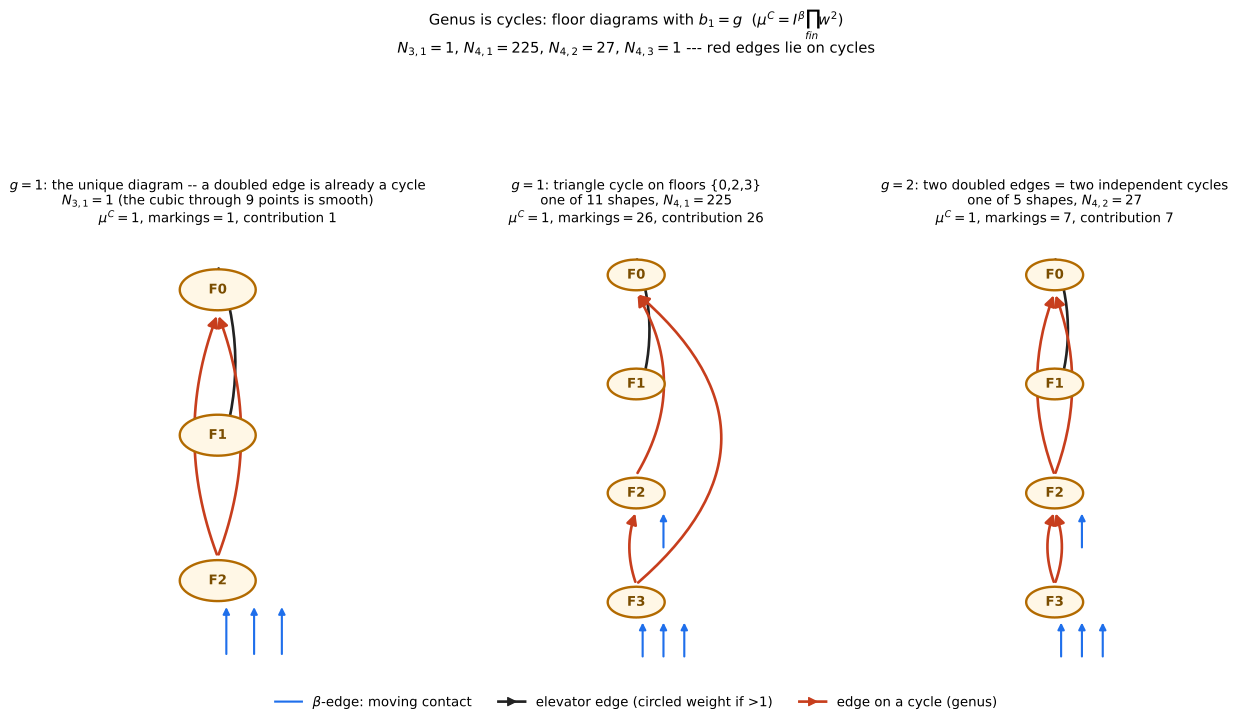
Figure 6.1 — Three panels: the unique (3,1) diagram (doubled edge =
the first cycle), a (4,1) diagram whose cycle is a genuine triangle
on floors {0,2,3} (μ = 1, 26 markings — the largest single marking
count in the chapter), and a (4,2) diagram with two doubled edges =
two independent cycles. Cycle edges in red. Every panel was checked
by the chapter program — axioms, b₁ = g, multiplicity, markings —
before it was rendered.
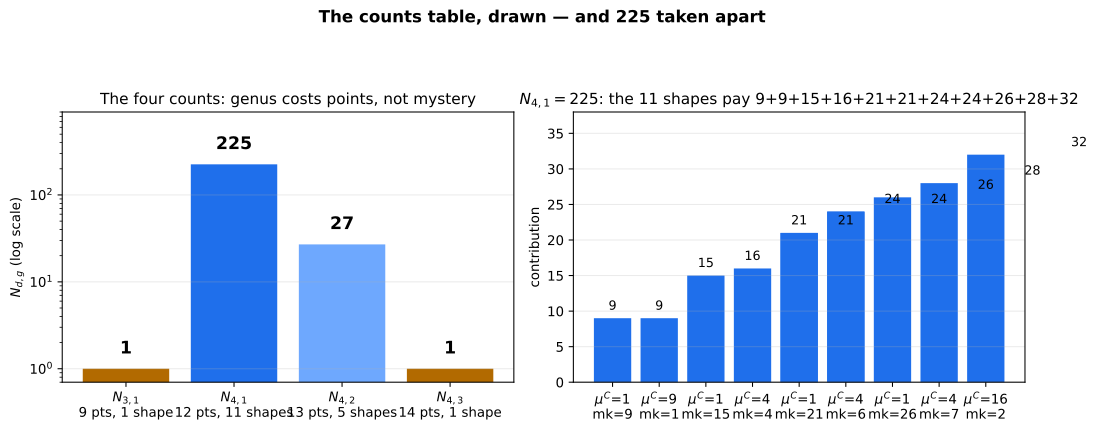
The table, drawn. Left: the four counts — note that genus 3 costs
two more points than genus 1 and collapses back to a single shape.
Right: 225 taken apart; the biggest bar (32) is the shape with two
weight-2 elevators (μ^C = 2²·2² = 16) and only 2 markings, while
the 26-marking triangle shape contributes 26. Markings and
multiplicity trade off all the way down the list.
Honest Box — what the witnesses are. The node-polynomial formulas are checks, quoted from Vainsencher and Steiner via the Day 5 log — this chapter does not derive them. The chapter’s claims are the tropical counts; the classical formulas are the independent witnesses those counts have to answer to, and the program asserts the formulas’ values (225, 21 = C(7,2), 27) alongside the enumerations.
6.3 The whole chapter, as a program
Everything in this chapter is one runnable program: ch06_genus_floor_diagrams.py — self-contained: Chapter 5’s relative machinery is inlined, then the genus extension (multiset enumeration, multiset-preserving automorphisms). The assertions are the chapter’s claims — all four totals, every per-shape contribution above, b₁ = g on every shape, the classical witnesses as formulas, and a robustness re-run with the finite-edge weight bound raised from d to d+1 for (3,1), (4,1) and (4,2) (no new diagrams; the bound is exhaustive). One honest limitation, stated in the program’s header: N_{4,3} is not re-run at bound d+1 — its bound-d enumeration already takes about a minute, and the exhaustive-bound argument is the same upward-closed one as Chapters 4–5. Run it, and if it prints its final line, the counts are what we said they are. (This section used to print the listing inline; a screenful of code you can download is just a download with extra scrolling.)
6.4 Try It
- A diagram on 4 floors has 6 finite edges. What is its genus?
- Why can’t a doubled edge appear in a genus-0 diagram? Answer in
one sentence using
b₁. - How many points does
N_{5,1}run through, by the formula3d − 1 + g?
Answers
- 1.
g = b₁ = 6 − 4 + 1 =3. - 2. A doubled edge already makes
b₁ ≥ 1, but genus 0 meansb₁ = 0— the finite edges must form a tree, and a tree has no parallel edges. - 3.
3·5 − 1 + 1 =15 points.
What we learned
- Genus is a cycle count. One formula,
b₁ = |E_fin| − d + 1, turns the genus from a property of an unseen classical curve into something visible in the diagram — and the smallest cycle is just a doubled elevator. - The machinery didn’t care. Divergence, markings, multiplicity
and the correspondence theorem were already stated for general
g; the only real work was combinatorial honesty — multisets in the enumeration, multisets in the automorphisms. - Every count has a witness. 1, 225, 27, 1 each meet an independent classical formula or uniqueness fact. Part II’s counting is now complete in both directions Chapter 4 opened: tangency (Chapter 5) and genus (this chapter).
Next
An interlude for programmers. Chapter 7 leaves curves behind and looks at the semiring itself as linear algebra: min-plus matrix powers are shortest walks, the Kleene star is Floyd–Warshall, and the tropical eigenvalue is a minimum cycle mean — Karp’s algorithm and the assignment problem turn out to be the same subject wearing different hats.
Source & provenance: Day 5 (2026-10-15) of the tropical geometry
study — code hidden_files/code/day05_genus.py (run log
hidden_files/day05-run.log, shapes in
hidden_files/code/day05_shapes.json), figure
files/figures/day05-genus-is-cycles.png, study log Day 5 entry.
Definitions: Dedieu arXiv:2511.21123 (1.1)–(1.2) at general genus;
classical witnesses: Vainsencher node polynomials, Steiner’s
3(d−1)². The chapter program was made self-contained and re-run
end-to-end on 2026-11-03 while finishing this chapter: all
assertions passed, including all four totals, the per-shape
breakdowns, b₁ = g on every shape, and the weight-bound
robustness re-runs noted in §6.3. Figures regenerated as SVG the
same day: code hidden_files/code/ch06_extra_figures.py, which
imports the chapter program and asserts each drawn shape’s axioms,
genus, multiplicity and markings — and every bar in the counts
figure against a fresh enumeration — before rendering.
Chapter code
The full program behind this chapter, as a download: ch06_genus_floor_diagrams.py — the same file §6.3 points at. Its assertions are the chapter’s claims; run it.