Chapter 5 · Part II — Counting curves by taking them apart
Tangency Is Just Floors Being Stubborn
Ask a curve to touch a line instead of just passing through points — and where the touch must happen changes the count completely.
Chapter 4 counted curves through points. But algebraic geometers also
ask curves to touch things: to meet a fixed line L not transversally
but with a prescribed contact order — a tangency. Ask a cubic to be
tangent to L, or to meet it in one double point and one simple point,
and the count changes completely: 12 becomes 36, or 10,
depending on where the contacts are required to happen.
That last distinction is the chapter’s whole idea:
- A fixed contact (an
αcontact): the point of tangency onLis prescribed in advance. The curve must touchLthere. - A moving contact (a
βcontact): the curve must be tangent toLsomewhere, but it gets to choose where.
Fixed is stricter, moving is freer, and floor diagrams keep the two apart with two kinds of infinite edge. Everything else — the floors, the divergence budget, the markings — is Chapter 4’s machinery, unchanged. Prediction, before we compute: the counts should still be specific small integers, they should match the primary source per shape and not just in total, and if we switch all the tangencies off in the right way the machinery must hand us Chapter 4’s 12 back.
5.1 Relative floor diagrams
Everything from Chapter 4 survives — d floors, divergence
in − out = 1 at every floor (Dedieu (1.1)–(1.2)), acyclicity,
connectedness. What changes is the type (α, β) of the infinite
edges (Dedieu (1.4)–(1.5)):
- exactly
α_i + β_iinfinite edges of weighti, for eachi; - the
αones are the fixed contacts, theβones the moving contacts; - there are still exactly
dfloors (Lemma (1.5)(i)) — tangency conditions redistribute the infinite edges; they do not add floors.
The count N_0^{3,irr}(α, β) is the number of irreducible rational
cubics with α_i order-i contacts at fixed points of L and β_i
order-i contacts at moving points, through
2d + g − 1 + |β| further general points
Note what is not in that formula: |α|. A fixed contact consumes a
condition by prescribing its point, so it does not add a point to pass
through; a moving contact does.
The multiplicity picks up a factor for the moving contacts (Dedieu (1.1)):
μ^C(D) = I^β · Π over finite edges e of w(e)², I^β = Π_i i^{β_i}
A moving contact of order i pays a factor of i; a fixed contact
pays nothing extra — its cost was already paid by prescribing the
point.
5.2 The subtle part: how fixed edges are labelled
Markings work as in Chapter 4 — labels strictly increasing along the incidence poset, counted up to automorphism — with one subtlety that is worth a box, because the study got it wrong first and the source had to correct it.
Honest Box — the fixed edges ARE labelled. The study’s first implementation treated the
α-infinite edges as unlabelled, dividing by their permutations inside the automorphism count. The source says otherwise (Dedieu (1.6)): theαedges are labelled — with the non-positive labels{−|α|+1, …, 0}— and the labels within each weight class permute freely, contributing a factorΠ_k (α_k)!to the marking count. In the two cases computed below that factor is 1, so the numbers were unaffected — but the code was fixed anyway, because a chapter that is only right on its examples is not right. The chapter program implements (1.6) as printed.
Precisely: labels {1, …, 2d+g−1+|β|} go on floors, finite edges and
β edges; the α edges carry the non-positive labels above.
5.3 The two counts: 36 and 10
Case 1: N_0^{3}(0, [1,1]) = 36. No fixed contacts; two moving
contacts, of orders 1 and 2 (β_1 = β_2 = 1, so I^β = 2). The
curves pass through 2·3 + 0 − 1 + 2 = 7 further general points.
Three shapes:
| Markings | μ^C | Contribution |
|---|---|---|
| 6 | 2 | 12 |
| 4 | 2 | 8 |
| 2 | 8 | 16 |
| Total | 36 |
Case 2: N_0^{3}([0,1], 1) = 10. One fixed contact of order 2
(α_2 = 1) and one moving simple contact (β_1 = 1, so I^β = 1).
The curves pass through 2·3 + 0 − 1 + 1 = 6 further general points.
Three shapes:
| Markings | μ^C | Contribution |
|---|---|---|
| 3 | 1 | 3 |
| 3 | 1 | 3 |
| 1 | 4 | 4 |
| Total | 10 |
Both totals — and both per-shape breakdowns — match Dedieu’s Example
(1.3) per shape, not just in sum (2×8 + 4×2 + 6×2 and 1×4 + 3 + 3
in the source’s ordering). Matching a total could be luck or two
errors cancelling; matching every summand is the correspondence rule
implemented correctly.
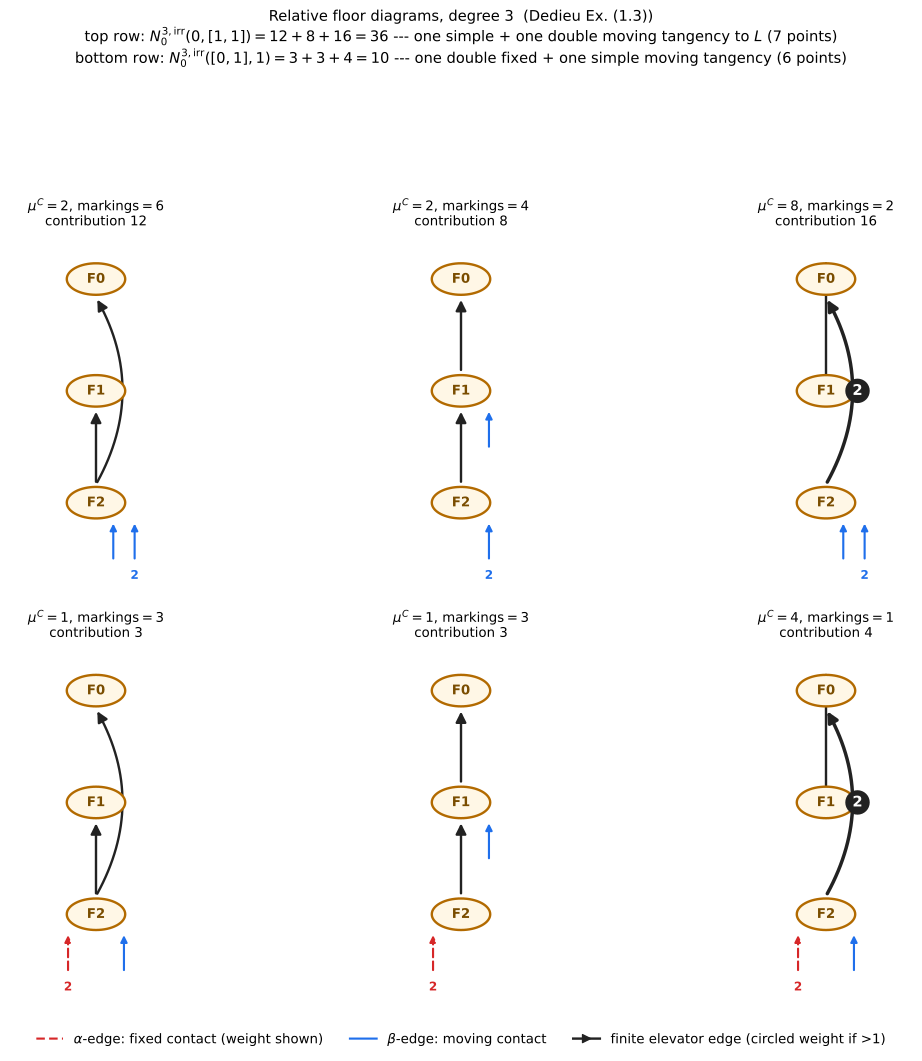
Figure 5.1 — The six shapes. Blue stubs are moving (β) contacts; the red dashed stub is a fixed (α) contact of weight 2: the curve must touch the line at exactly that prescribed point, with contact order 2. Every shape drawn here was checked by the chapter program — diagram axioms, multiplicity, and markings — before it was rendered.
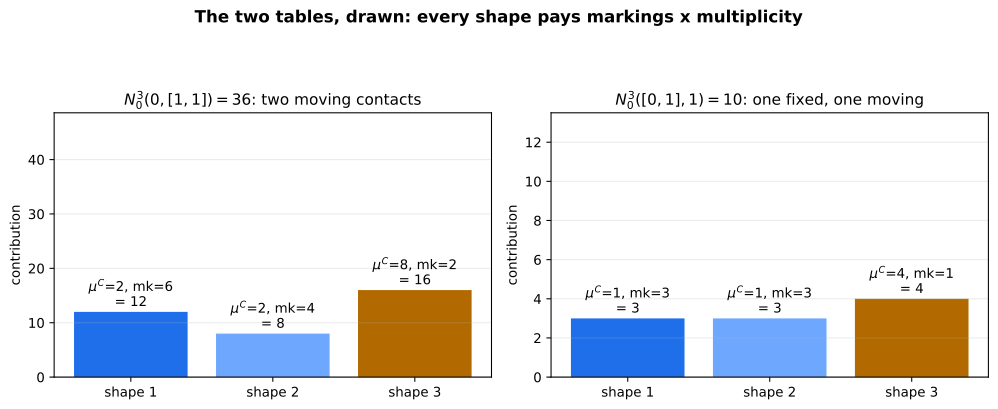
The two tables, drawn. Read the biggest bar of the 36 first: only 2
markings, but μ^C = 8 — a weight-2 elevator (2² = 4) times the
moving double contact’s I^β = 2. Tangency pays in multiplicity what
it costs in freedom.
And the sanity check that ties the chapter back to Chapter 4: with
α empty and β = {1:3} — three moving simple contacts, which is no
tangency condition at all — the relative machinery reproduces the
absolute count N = 12. The program asserts it.
Honest Box — a count this chapter does not make. There is a famous real count nearby: Welschinger’s
W_3 = 8, the signed count of real rational cubics. It is not obtainable from Dedieu’s lectures — a full-text check on Day 4 found that “floor diagram” and “real” never meet there. Getting 8 honestly needs a different source (Brugallé–Mikhalkin’s real paper, or Shustin). This chapter claims 36 and 10, and nothing about 8.
5.4 The whole chapter, as a program
Everything in this chapter is one runnable program: ch05_relative_floor_diagrams.py. The assertions are the chapter’s claims — the per-shape tables above, both totals, the absolute-count sanity check, and a robustness re-run with the finite-edge weight bound raised from d to d+1 (no new diagrams; the bound is exhaustive). Run it, and if it prints its final line, the counts are what we said they are. (This section used to print the listing inline; a screenful of code you can download is just a download with extra scrolling.)
5.5 Try It
- The fixed/moving asymmetry. Why does a fixed order-2 contact
contribute no
I^β-style factor, while a moving one contributes 2? - Count the points. In Case 2, how many further general points
do the curves pass through? (Use
2d + g − 1 + |β|withd = 3,g = 0,|β| = 1.) - A heavy shape. A relative diagram has one finite edge of
weight 2,
β = {1:1, 2:1}, and 3 markings. What is its contribution?
Answers
- 1. The factor
I^β = Π i^{β_i}is part of the multiplicityμ^C(Dedieu (1.1)), and it is indexed byβonly: a moving contact of ordericontributesi. A fixed contact’s point is already prescribed, so the correspondence charges it nothing extra — its strictness shows up instead in which diagrams occur and how few markings they have (Case 2’s shapes have 3, 3, and 1). - 2.
2·3 + 0 − 1 + 1 =6 points — and note|α|does not appear: the fixed contact is a condition onL, not a point to pass through. - 3.
μ^C = I^β · Π w² = (1·2) · 2² = 8; contribution8 · 3 =24.
What we learned
- Tangency is data, not decoration. Splitting the infinite edges
into fixed (
α) and moving (β) turns one counting problem into a family — and the same enumeration answers all of it. - Fixed and moving are genuinely different conditions. They
differ in the point count (
|β|appears,|α|does not), in the multiplicity (I^βcharges moving contacts only), and in the labelling (fixed edges carry their own non-positive labels). - Per-shape agreement is the real verification. 36 and 10 match the source summand by summand; the absolute 12 falls out as the degenerate case. The machinery of Chapter 4 survived being asked a harder question.
Next
Chapter 6 breaks the rule this part has lived by: genus 0 meant
trees, and trees meant no parallel edges. Allow a doubled elevator
and the diagram grows a cycle — genus stops being a hypothesis and
becomes something you can count in the picture: N_{3,1} = 1,
N_{4,1} = 225.
Source & provenance: Day 4 (2026-10-14) of the tropical geometry
study — code hidden_files/code/day04_relative.py (run log
hidden_files/day04-run.log), figure
files/figures/day04-relative-floor-diagrams.png, study log Day 4
entry. Definitions verified on Day 4 against T. Dedieu,
arXiv:2511.21123, Lecture IX (1.1)–(1.6) and Example (1.3). The
chapter program was re-run end-to-end on 2026-11-02 while finishing
this chapter: all assertions passed, including both per-shape
breakdowns, the absolute-count sanity check (N = 12), and the
weight-bound robustness re-run at d+1. Figures regenerated as SVG
the same day: code hidden_files/code/ch05_extra_figures.py, which
imports the chapter program and asserts each drawn shape’s axioms,
multiplicity and markings — and that the drawn set is exactly the
program’s enumerated set — before rendering.
Chapter code
The full program behind this chapter, as a download: ch05_relative_floor_diagrams.py — the same file §5.4 points at. Its assertions are the chapter’s claims; run it.